Writings
Digital edition of the texts published by Jean-Marc Philippe, transcribed from the original editions kept in his archives. The page numbers of the original edition are given in the margin.
Writings by Jean-Marc Philippe
 Directed Sound Psycho-structuresin J.-C. Quiniou, G. Verroust, J.-M. Font, J.-M. Philippe and C. Marenco, Les cerveaux non humains, Paris, Denoël, “Le point de la question” series, 1970, pp. 210-223.Jean-Marc Philippe sets out a method of computer-assisted sound creation, “Directed Sound Psycho-Structures” (P.S.S.D.), based on acoustics, physiology, musicology and information theory. He describes an experimental set-up for measuring the listener's psycho-physiological reactions to sound signals, a schematic diagram of the final installation, some results and possible applications (the metro, airports, music therapy, total spectacle). He concludes by distinguishing five functions of the computer and by asserting that, in this approach, it is the instrument itself that has changed in nature.
 Science and Art: Towards a New Kind of DialogueSpirales. Journal de culture internationale, no. 20-21 (“La Deuxième Renaissance”), November-December 1982, pp. 58-60.Jean-Marc Philippe describes the relations between art and science: first a surface relation (the borrowing of means, forms and technical systems), then a deeper relation in which science is called upon for its method and its powers of analysis. Starting from a musical example (a hypercube rotating on a grid, associated with scores), he heralds a new art, emerging from groups of people with technological means at their disposal, which would address the mind more than individual sensibility.
 The Celestial WheelL'Hippocampe, no. 2, April 1984, pp. 55-58.The first text presenting the Celestial Wheel: an account of the August night when Jean-Marc Philippe watched an artificial satellite pass overhead, followed by an exposition of the principle of a crown of geostationary satellites (a circle with a radius seven times that of the Earth) equipped to emit a light signal at least as bright as Venus. He describes lighting configurations (a time signal at 0:00, 8:00 and 16:00 UT, a garland, an SOS in Morse code), how it would be perceived depending on latitude, and the symbolic import of the work.
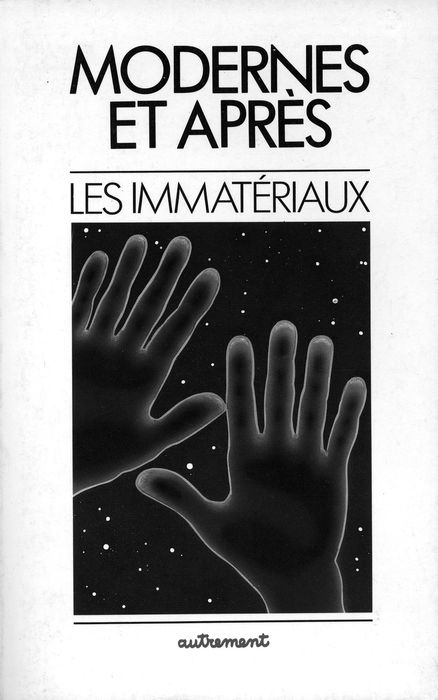 Artistic Invention and its Metamorphosisin Modernes et après : « Les Immatériaux », Paris, Autrement, 1985, pp. 173-182.Jean-Marc Philippe analyses the era as an extraordinary opportunity for artists (the collapse of classical references, the opening up of knowledge across disciplines, the multiplication of media) and describes the three directions of his work: canvases with a white, stripped-down pictorial space (the “19 Gazes”), the “imagiques” (electronic manipulation of the image) and the “Celestial Wheel”. This last project consists of lighting up on demand, on some thirty to forty geostationary satellites, a light signal tracing a great circle in the sky, with a first illumination hoped for on 1 January 2000.
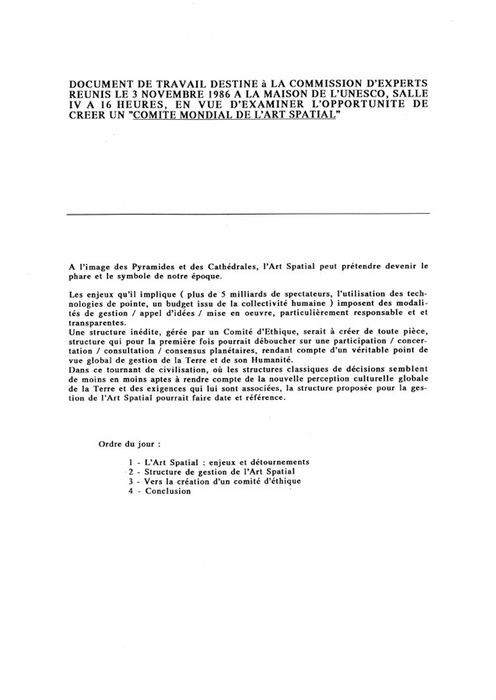 World Space Art Committee: Working PaperTypewritten working paper (7 pages) submitted to the committee of experts convened on 3 November 1986 at the Maison de l'UNESCO, Paris.A working note proposing the creation of an Ethics Committee (“World Space Art Committee”) charged with managing, in a concerted and transparent way and on a planetary scale, the first realisation of space art, conceived as a collective celebration bearing the signature of no artist, institution or nation. It sets out the stakes, the warnings (propaganda, private interests), a ten-stage protocol (call for ideas, technical committee, planetarium simulation, planetary referendum) and funding hypotheses based on a levy on military budgets or on gross national product.
 When Art, Space and Dreams Meet… and When Reflection Becomes NecessaryPhréatique. Langage et création, no. 49, summer 1989, pp. 107-116.Jean-Marc Philippe presents two concepts of space art: the “Celestial Wheel”, a crown of geostationary satellites that would light up in the sky, with its configurations, its envisaged funding and its adventure since 1980; then the “Message from Humankind to the Universe” operation (messages collected via Minitel and transmitted from Nançay on 26 January 1987). He also recounts the ethical reflection conducted at UNESCO on 3 November 1986, which led to the project of a “World Ethics Committee for a Peaceful Use of Space”. The text ends with excerpts from the messages and an AFP news dispatch of 26 January 1987.
 From the Infinitely Small to the Infinitely Large: Matter / Memory / Interactivity / Cosmosin Les Transinteractifs, proceedings of the conference of 4 and 5 November 1988 (Centre culturel canadien, Paris), “Déchiffrages” series edited by Frank Popper, pp. 82-87.Jean-Marc Philippe presents the “Totem of the Future”, a metal sculpture in nickel/titanium shape-memory alloy whose forms change with temperature and the seasons, made with the Raychem group (Menlo Park, California). He explains why he deals here with these evolving memory sculptures rather than with the “Messages from Humankind to the Universe” operation, and recalls in his notes the Celestial Wheel, that operation and an award he received in 1987.
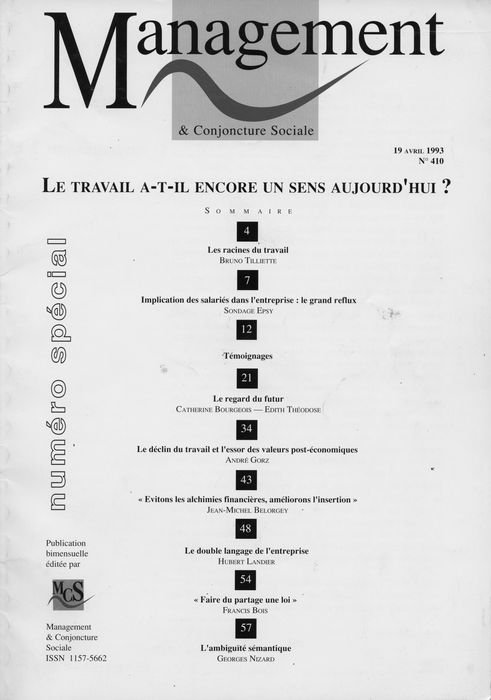 Does Work Still Have Meaning Today? (testimony)Management & Conjoncture sociale, no. 410 (“Le travail a-t-il encore un sens aujourd'hui ?”), 19 April 1993, p. 20.An artist's answer to the question of the meaning of work: for Jean-Marc Philippe, when he is working on something that makes sense, he “is not working but is”, and he draws no distinction between the moments when he strolls and dreams and those when he works. He speaks of the lack of time to bring his work to fruition, the price paid by those close to him, and artistic creation as an antidote to emptiness and anguish.
 Space artin Raymond Daudel and Nicole Lemaire d'Agaggio (eds), La science et la métamorphose des arts, Paris, Presses universitaires de France, 1994, pp. 141-160.Jean-Marc Philippe traces the birth of space art in the 1970s and 1980s through four pioneers (Pierre Comte, Joseph Mac Shane, Jean-Marc Philippe, Tom Van Sat) and their projects, among them the “Celestial Wheel” (1975) and the “Message from Humankind to the Universe” operation (1986-1987). He recalls the committee of experts convened at UNESCO in November 1986, then the legal, physical (debris, light pollution), financial and ethical questions raised by this new art, and concludes on what is at stake: a new humanism on a planetary scale.
 What if Exercising “Full Responsibility” Proved to Be Transdisciplinary in Nature, and if Ethical Reflection Should Henceforth Include Artistic PerceptionJournal international de bioéthique, vol. 5, no. 1, March 1994, pp. 35-38.Jean-Marc Philippe distinguishes four forms of knowledge (local consensual, scientific, artistic, revealed) and argues that the production of scientific knowledge, which has become hypertrophied, is throwing Western societies off balance. He makes the case for a transdisciplinary ethical reflection that incorporates artistic perception, and discusses his role in the “World Ethics Committee for a Peaceful Use of Space”.
 Cultural Matrix and Artistic Creation: From the Classical Practice of One's Art to Transdisciplinarityin Michel Cazenave and Basarab Nicolescu (eds), L'Homme, la science et la nature : regards transdisciplinaires, Aix-en-Provence, Le Mail, “Science et conscience” series, 1994, pp. 232-264.Jean-Marc Philippe describes the “cultural matrix” of wealthy techno-cultural societies, marked by the exponential acceleration of knowledge and techniques and by the difficulty artistic creation has in finding its place within a market economy. He presents four artistic concepts born of interdisciplinarity and then of transdisciplinarity: the shape-memory sculptures, the “Celestial Wheel”, the “Messages from Humankind to the Universe” operation and the “Royalties/Jardin/Terre [Royalties/Garden/Earth]” project (a tithe for the benefit of the Earth, considered as a legal person, and a worldwide structure for reflection and management).Sculpture and New Materialin Raymond Daudel and Nicole Lemaire d'Agaggio (eds), La science et la métamorphose des arts, Paris, Presses universitaires de France, 1994, pp. 103-123.Jean-Marc Philippe places the appearance of shape-memory alloys within the history of the artist's tools and materials, then sets out the research programme carried out with industry (Raychem, California) to adapt them to sculpture. He presents three concepts of evolving memory sculpture: the bust “Hermaphrodite” (1987), the “Totem of the Future” (1989) and the “Gate of the Two Infinities”, and concludes with a critical assessment of the junction between art and technology.
Writings on Jean-Marc Philippe
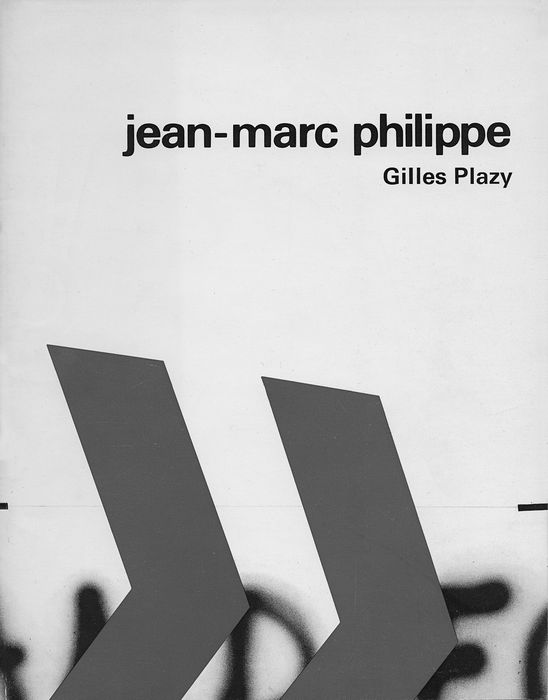 Gilles PlazyJean-Marc Philippe (Galerie Attali catalogue)Gilles Plazy, “Jean-Marc Philippe”, catalogue of the exhibition Œuvres récentes, Paris, Galerie Attali, 1976 (extract from the journal Cimaise).A text by Gilles Plazy on Jean-Marc Philippe's painting, presented in the catalogue of his exhibition at the Galerie Attali in 1976. Plazy situates the painter as a “son of the rupture” between figuration and abstraction, traces his shift from the gestural lyrical abstraction to a rigorous geometry shot through with fissures (trompe-l’œil, drips, erasures, traces of writing), and concludes that his painting is “painting itself”.
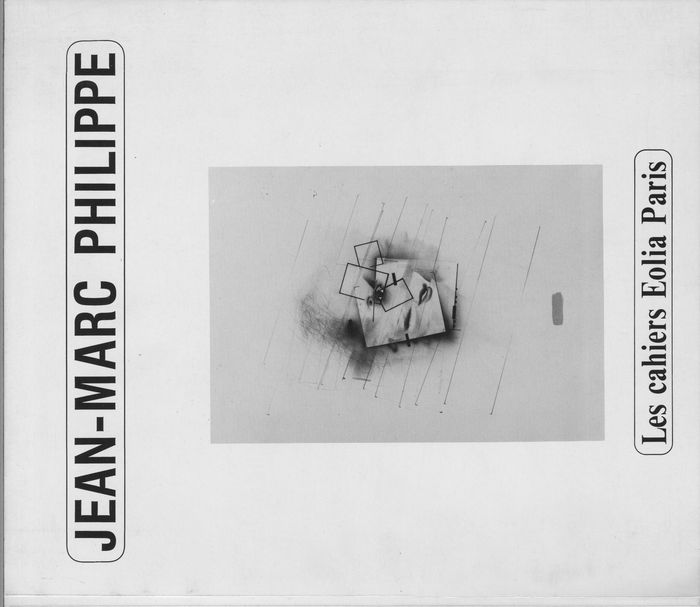 Galerie EoliaThe White Work (Galerie Eolia catalogue)Jean-Marc Philippe. Œuvres récentes 1976-1984 : l'Œuvre blanche, Paris, Galerie Eolia, “Les Cahiers Eolia” no. 2, 1985.Catalogue of Jean-Marc Philippe’s exhibition “L’Œuvre blanche” at the Galerie Eolia (Paris, 1985), devoted to the “Gazes”, “Smiles” and “Snapshots” series (18 plates). It contains an unsigned introductory text (in French and English) that also mentions the Celestial Wheel project and the work on a mask from Benin, the list of the artist’s exhibitions, writings, conference contributions and publications between 1970 and 1985, a biographical entry taken from Bénézit and a short bibliography.
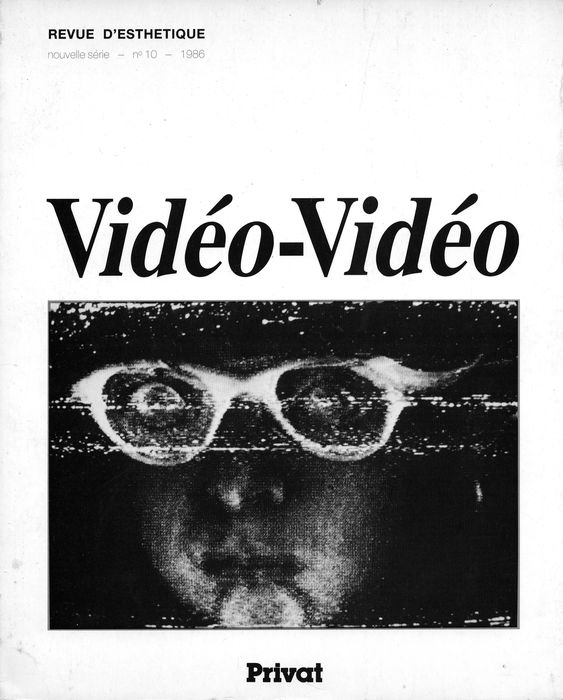 Gilles TordjmanPortrait of the Artist on VideoGilles Tordjman, “Portrait de l'artiste en vidéo”, Revue d'esthétique, no. 10 (“Vidéo-Vidéo”), Toulouse, Privat, 1986, pp. 155-158.An article by Gilles Tordjman devoted to Jean-Marc Philippe in the “Vidéo-Vidéo” issue of the Revue d’esthétique. He describes the plurality of his practices (drawing, computer, video, welding), his work on the still video image and on artificial colours based on objects such as a mask from Benin or a self-portrait by Van Gogh, his Celestial Wheel project (some forty satellites, presented at the second Franco-Japanese Cultural Summit in June 1985) and his research on shape-memory alloys, exhibited at the Festival of Industry and Technology at La Villette.