Shape-memory alloys
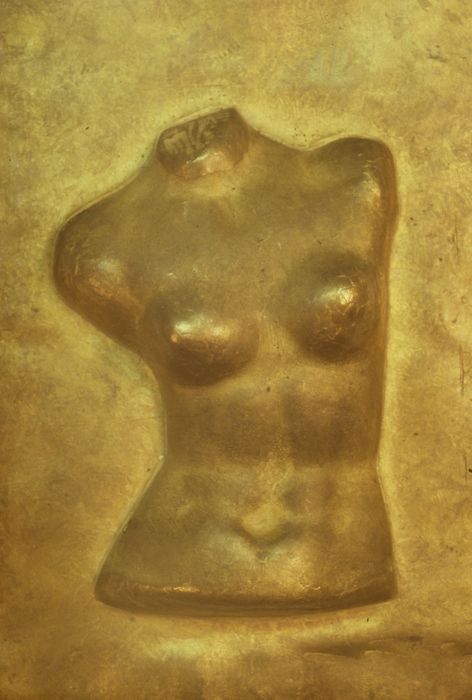
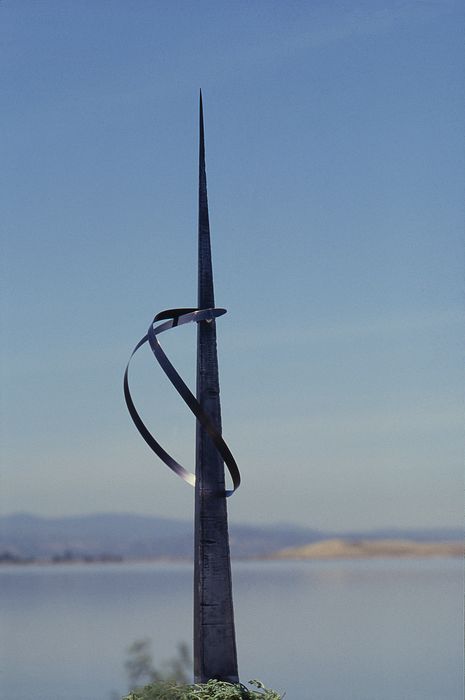
As early as the 1930s, scientists sensed that certain metal alloys could memorise shapes, which they would then be able to recover through temperature variations alone. From the 1960s onwards these properties were studied by the leading atomic physics laboratories around the world. Numerous industrial applications began to emerge in the 1980s, particularly in the aeronautical and medical fields.
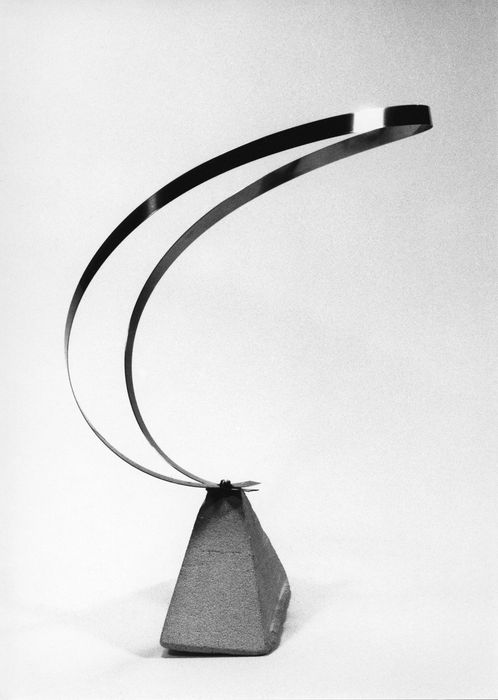
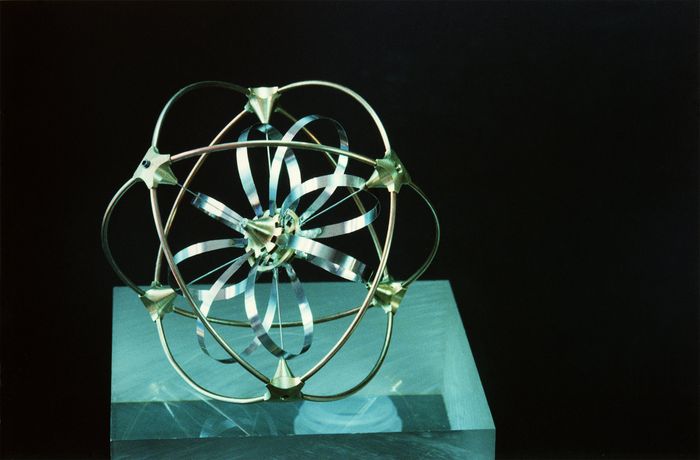
Jean-Marc Philippe was the first artist to seek to use these alloys for artistic and monumental purposes. Thanks to the support of the Raychem Corporation group, then the world leader in this technology, he was able, between 1986 and 1990, to carry out the research needed to make his works. The engineer Philippe Poncet devoted several years of full-time work to it, himself backed by the world specialist in these nickel/titanium alloys, Tom Duerig, not to mention the help of several technicians, all belonging to the “Metal Division” of the Raychem group based in Menlo Park, California.
Listen
Recordings © Radio France / INA and Radio suisse romande, made available for documentary purposes.
Writings
By Jean-Marc Philippe
- From the Infinitely Small to the Infinitely Large: Matter / Memory / Interactivity / Cosmos — in Les Transinteractifs, proceedings of the conference of 4 and 5 November 1988 (Centre culturel canadien, Paris), “Déchiffrages” series edited by Frank Popper, pp. 82-87.
- What if Exercising “Full Responsibility” Proved to Be Transdisciplinary in Nature, and if Ethical Reflection Should Henceforth Include Artistic Perception — Journal international de bioéthique, vol. 5, no. 1, March 1994, pp. 35-38.
- Cultural Matrix and Artistic Creation: From the Classical Practice of One's Art to Transdisciplinarity — in Michel Cazenave and Basarab Nicolescu (eds), L'Homme, la science et la nature : regards transdisciplinaires, Aix-en-Provence, Le Mail, “Science et conscience” series, 1994, pp. 232-264.
- Sculpture and New Material — in Raymond Daudel and Nicole Lemaire d'Agaggio (eds), La science et la métamorphose des arts, Paris, Presses universitaires de France, 1994, pp. 103-123.
On Jean-Marc Philippe
- Portrait of the Artist on Video — Gilles Tordjman, “Portrait de l'artiste en vidéo”, Revue d'esthétique, no. 10 (“Vidéo-Vidéo”), Toulouse, Privat, 1986, pp. 155-158.
References and links
Books, catalogues and journals
- Philippe Poncet, “Art and Shape-Memory Alloys: Jean-Marc Philippe”, Leonardo, vol. 22, no. 1, MIT Press, January 1989, pp. 117-120.
- Christiane Galus, “Le mouvement qui déplace les lignes”, Le Monde, 25 May 1988, p. 23.
- Isabelle Lécuyer-Dujardin and Dimitra Markovitsi, “Les nouveaux matériaux – Sculpture à mémoire”, Théma, vol. 5 “Sciences et techniques”, Paris, Larousse, 1994, p. 349.
- Lionel Salem, La Science dans l'art, Paris, Odile Jacob, 2000, chapter “La science ‘mise en art’”, pp. 25-48.
- Frank Popper, L'art à l'âge électronique, Paris, Hazan, 1993, pp. 130-131.
- Jacqueline Brenot, “Totem du Futur”, in L'Europe des créateurs : Utopies 89, Paris, Association des entreprises pour le Bicentenaire, 1989, pp. 16-21 (record).
KEO press
- Véronique Maurus, “Retour vers le futur”, Le Monde, 16 August 1998 (online).
Online resources
- Leonardo Awards Program: list of award winners, Leonardo / ISAST.
- Jean-Marc Philippe, ISEA Symposium Archives.
Digitised articles
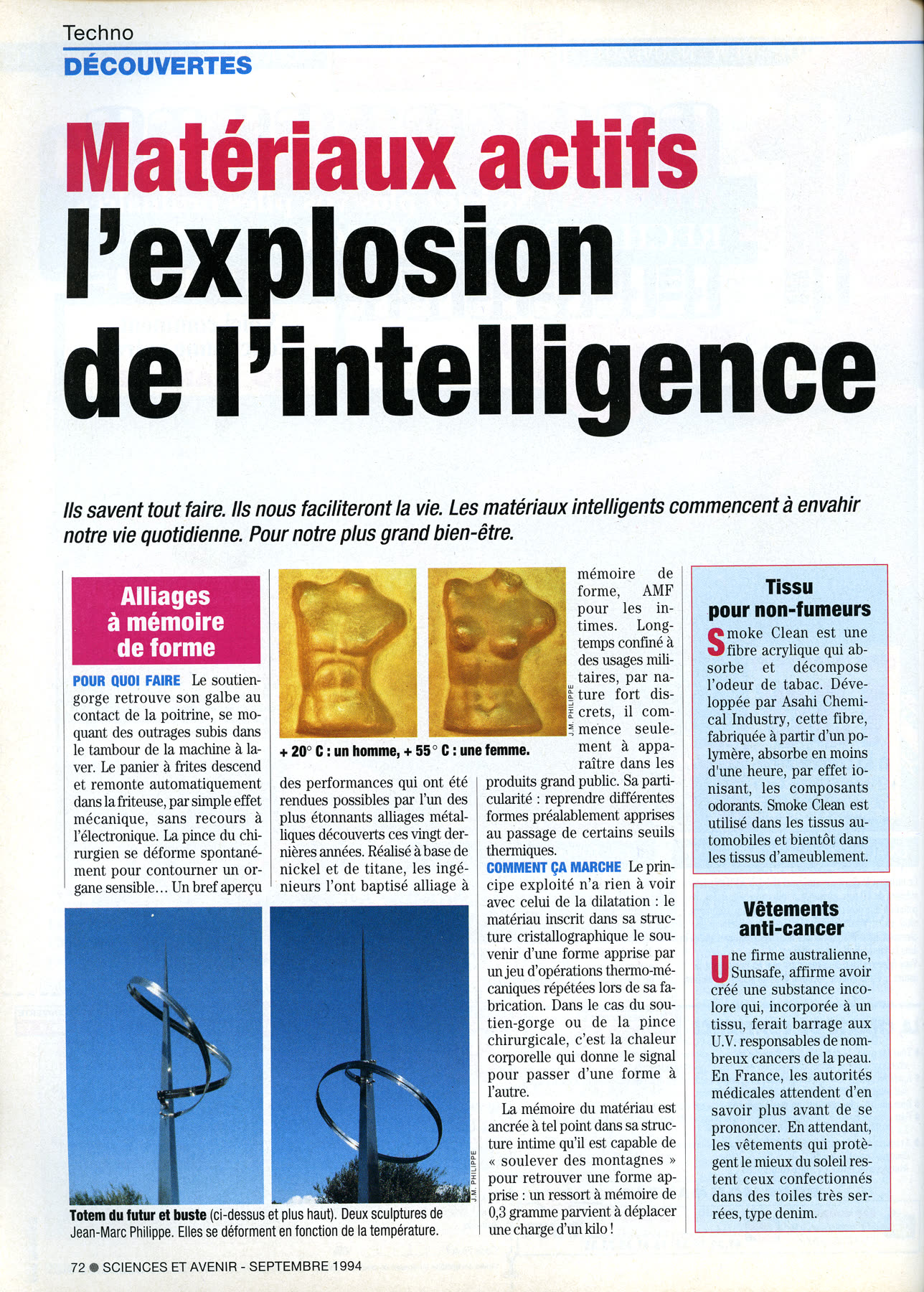
“Matériaux actifs : l'explosion de l'intelligence” — Sciences et Avenir, no. 571, September 1994, p. 72