Portrait of the Artist on Video
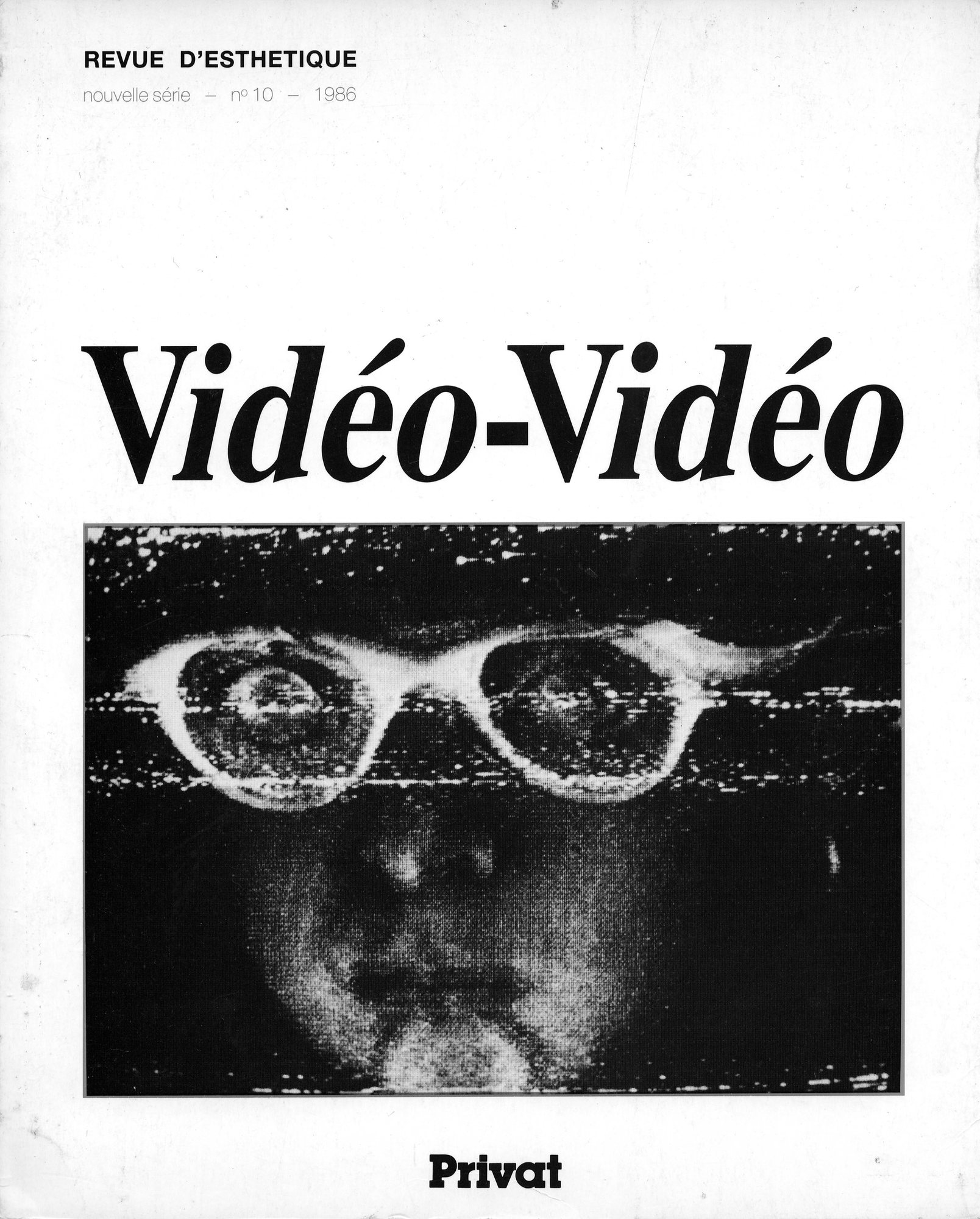
Gilles Tordjman, “Portrait de l'artiste en vidéo”, Revue d'esthétique, no. 10 (“Vidéo-Vidéo”), Toulouse, Privat, 1986, pp. 155-158.
See: Shape-memory alloys, Space art, Autopsy of a Mask, The Great Celestial Wheel, The Variations
Translated from the French.
p. 155
An age rich in contradictions is never short of slogans. The latest, neither worse nor better than any other, enjoins us to communicate – whatever the situation, the nature of the message or the identity of those communicating. From cliché to platitude by way of the hoary truism, the choice of images and catty metaphors is fortunately wide enough to evoke this communication, adorned with every invigorating virtue that an imagination in crisis cares to lend it. The first victim of this inflation of dialogue spinning in the void is video, that fantastic little machine which in record time has become a kind of obligatory rite of passage for creation present and to come, the paragon of a “modernity” more nebulous than ever.
In this respect, Jean-Marc Philippe is an artist unlike any other. Handling the pencil as readily as the computer, astrophysics as readily as the soldering iron, he has pursued the plurality of means of expression into its furthest recesses. When one learns, moreover, that he talks about his work with astonishing intelligence, one feels that all this deserves, at the very least, an investigation.
The Misfortunes of Dispersion
On the seventh floor of an anonymous tower block, in one of those districts of the capital that drift towards the periphery while seeming to remember the centre, Jean-Marc Philippe’s studio gives the visitor the impression of entering a sanctuary of the discontinuous, even of the incoherent: Indian-ink drawings rub shoulders with computer-generated images, soldering irons and pencils sit side by side in the most perfect indifference. But that is not where the surprise lies. For it is indeed the approach itself, the singular path of a no less singular artist, that emerges as an aesthetic questioning whose novelty and importance it would be wrong to underestimate.
First of all, a telling anecdote if ever there was one: a few months ago, Jean-Marc Philippe was exhibiting three different kinds of work in three Parisian galleries at the same time. The critics’
p. 156
reaction was not long in coming: who was this presumptuous scatterbrain who could afford the luxury of hopping from one thing to another all over the Left Bank, taking up, what is more, space from which other artists, happy to settle for a single style and a single gallery, might have benefited?
A knee-jerk reaction against a backdrop of fantasised professional ethics – those who lecture others are often the least qualified for the task they pride themselves on – this a priori rejection would in no way deserve our attention were it not symptomatic of a genuine return to a certain religious monism. Exegesis cannot bear, and indeed never could bear, the simultaneous coexistence of diverse forms in the output of one and the same artist. It means no harm, exegesis, but it cannot help itself; it gets on its nerves. It tolerates daring, novelty, insolence, but all of this must still be signposted, identifiable, coherent: as long as César goes on compressing, Arman accumulating and the Figuration Libre painters go on doing Figuration Libre – as long, in short, as everyone works their own little business in their own corner – all will be for the best in the best of all possible worlds and in the most tubular of Parisian museums. It readily accepts that play of repetition and difference which gives contemporary creation all its savour, but only on the strength of a chronology, a succession in time – in short, an idea of progress, of the direction of history. Exit Proteus and his masks; buried are the artists who conjugate in the present tense those very differences of expression that are hunted down like truffles as soon as they are anchored in a biography where past and present retain a semblance of integrity. In short, what criticism cannot bear is dispersion, dissemination – that is, everything the technological revolution we are now living through will inevitably impose. It is all this that Jean-Marc Philippe tries to face as lucidly as possible: “Painting-as-painting seems to have run its course. The idea of the truth of things can no longer be written in a sentence, an apophthegm, a theory or even a picture. Faced with the splintering of information we are experiencing today, the work can now represent no more than a fragment of a situation: video, to mention only that, makes it possible to reach this image of fragmentation.”
Freeze-Frame
Let us talk about it, then. The truly passionate relationship Jean-Marc Philippe has with the “new images” is driven by the almost Ubuesque state of research in this field at present: colossal sums swallowed up by cutting-edge technologies, incredible energy expended for a result one hardly dares describe – three minutes and a bit during which silvery spheres glide between two rows of Graeco-Roman columns worthy of the worst of Bofill. Not to mention the series of little lizards biting their own tails to a synthesised jingle to keep viewers waiting before the evening news. Faced with such poverty, Jean-Marc Philippe’s approach to video is striking first of all for a rigour which, out of ignorance, one might dismiss as formalism. It is above all exploratory work on the image of an object, which may be, for example, a 16th-century Benin mask or a self-portrait by Van Gogh. Once the object has been captured on video, the image passes through an artificial-colour device. A first selection is then made: the data chosen by Jean-Marc Philippe are next digitised by computer to arrive finally at the definitive image, itself chosen from among other possible images. Laid out flat like this, Jean-Marc Philippe’s work might seem no more than a series of exercises in style – brilliant, certainly, but nonetheless limited in their aesthetic reach. Nothing of the sort. However systematic it may be, the exploration of a field of possibilities through a rigorous selection of diverse data brings contingency back to the surface where it was least expected: “More than exercises in style, this is an attempt to master the medium through practice. New technologies make it possible to arrive at statements one would never have thought of. Where new images are concerned, a new theoretical framework has yet to be invented: questions such as ‘what are they for?’ are null and void if one considers them through classical patterns of thought.” A will to renew aesthetic thinking which, for all its obvious necessity, is not without a certain danger: does one not run the risk, indeed, of subjecting the artist’s thought to the mere intelligibility of the workings of the new media with which he
p. 157
works? “Technology is nothing but what one wants to make it do. For two or three years I have been working on the medium (video) as such, but I mix it with the computer. What is at stake is twofold: on the one hand, to say as much as possible in as little time as possible; on the other, to work, through a new way of thinking about technology, towards the creation of a ‘new museum’, a place of endless variations without repetition, obtained by means of computing.” Which goes to show how much distance and circumspection such research may demand of anyone who ventures into it: just as easel painting is inevitably pushed to the margins in an artistic universe open to every material and every form, so the contemporary artist, if he sticks to the old ideological opposition of art and science, is condemned before long to the retrograde conformism of a romanticism of the century – such a thing exists – and a rather narrow one. This opening of art to science, which Jean-Marc Philippe so earnestly calls for, is neither a gimmick nor a fashion. It has nothing to do with that pedantry of home microcomputing outside which, we are asked to believe, there is no salvation. It implies no submission to technology. Far more than that, it is the only guarantee of subverting it: by crossing art and science, one also opens technology up to other modes of operation, to other applications than those originally assigned to it. In short, one makes the electrons swing, and it is hard to see by virtue of what adulterated moralism one should refrain from doing so. By using video as a device for generating still images, Jean-Marc Philippe does more, and better, than subvert the medium: he uses it against its everyday purpose, exploring the immobility that this fabulous box of movement – a simple video camera – can offer. A fixed capture of an inanimate object, the video image ceases to be a mere iconic record of displacement: it becomes inert minerality, and begins to vibrate with all its potentialities the moment it is frozen. The variations on artificial colours then seal this pact of arrested movement: to grasp the infinite variety of chromatic possibilities, there is nothing like the immobility of a life that is always already still. So as not to let ourselves be dominated by the technological tool, let us begin by using its perverse effects: that is, in a way, the only lesson – if lesson there must be – that can be drawn from Jean-Marc Philippe’s video work. And it is anything but anecdotal. To work the tool to its limit, at the frontier of its functions: at this price, and at this price alone, will contemporary creation be able to renew itself with intelligence.
The Space of Dreams – Melancholy of Metals
When Jean-Marc Philippe presented his Celestial Wheel project at the second Franco-Japanese Cultural Summit, held in June 1985, some people sniggered. It is true that there are people who do not like travelling. Yet this quixotic project follows logically from the reflection Jean-Marc Philippe has been pursuing for some years on the artistic use of Space.
The idea of the Celestial Wheel is its most representative expression: it involves using some forty satellites placed in the same orbit and fitting them with lighting devices that allow them to be lit up simultaneously. Set at equal distances from one another, they would form a kind of luminous crown around the planet, visible from every point on the globe. The idea, poetic in its very excess, is nonetheless backed by a solid dossier made up partly of applications to NASA, learned calculations, detailed sketches and a good deal of faith. In the same breath, Jean-Marc Philippe proposes, always with the same passion, the creation of a committee for the demilitarisation of space and its use for artistic purposes – nothing less – or again the launch of a mega-firework display from a satellite to mark the bicentenary of the French Revolution. Needless to say, Jean-Marc Philippe is working here at the edge of the possible, at the outer limit of the freedoms left to the artist by the political establishment. Needless to add, either, that he is looked at somewhat askance in the ministries, for what he is shaking up – more serenely, but just as surely, as the Greenpeace affair – is the States’ monopoly on cutting-edge technologies, the inevitability of militarisation that lies in wait for all scientific progress. The example of the Celestial Wheel, through its madness, its “hénaurme” and salutary insolence, shows once again that one can still disturb, still call things into question deeply and lastingly, with what will forever remain mere chimeras – possibilities dreamt.
The same problems with the institution, the same encroachment on reasons of State, with what must be
p. 158
called “the affair” of the Shape-memory alloys: alloys made of nickel and titanium, for example, but measured out in proportions that tolerate not the slightest approximation, the slightest imprecision, however infinitesimal. Their peculiarity: they can change shape according to the ambient temperature. Their incredible property: they are capable of “remembering” their earlier form, of keeping in their structure the memory of a “shaping”, and of returning to their initial form as soon as the temperature drops. Dreaming a little, this means that one could contemplate the Venus de Milo at minus five degrees and the Victory of Samothrace at twenty-five, and so on for as long as there are seasons… It all sounds like something out of a science-fiction script, and yet it is true, as visitors were able to see for themselves at the Festival de l’Industrie et de la technologie held at La Villette, where Jean-Marc Philippe exhibited the very first results of his research for the first time.
Just one problem, and a sizeable one: the way in which the alloys can be “educated” is still classified as a “defence secret”, which singularly limits the room for manoeuvre in any research one may carry out on the subject. So Jean-Marc Philippe waits, patiently, for a corner of the veil to be lifted. Meanwhile, in an entirely empirical way – groping, shaping, deforming – he seeks to teach the metal this mysterious formal consciousness, and sometimes, against all expectation, against secrecy, against the silence imposed, he finds…
For this diversity, for this profound understanding of fragmentation, for this refusal of ready-made thinking and for so many other reasons, Jean-Marc Philippe perfectly fits the definition of the artist on which people of good taste ought to agree: a pain in the arse of genius, who makes an aesthetic object out of a tool, stillness out of movement, art out of science, science out of a disconcerting whimsy, and mineral poetry out of State secrets.
Transcribed from the original edition (Jean-Marc Philippe archives), reproduced with the consent of the rights holders.