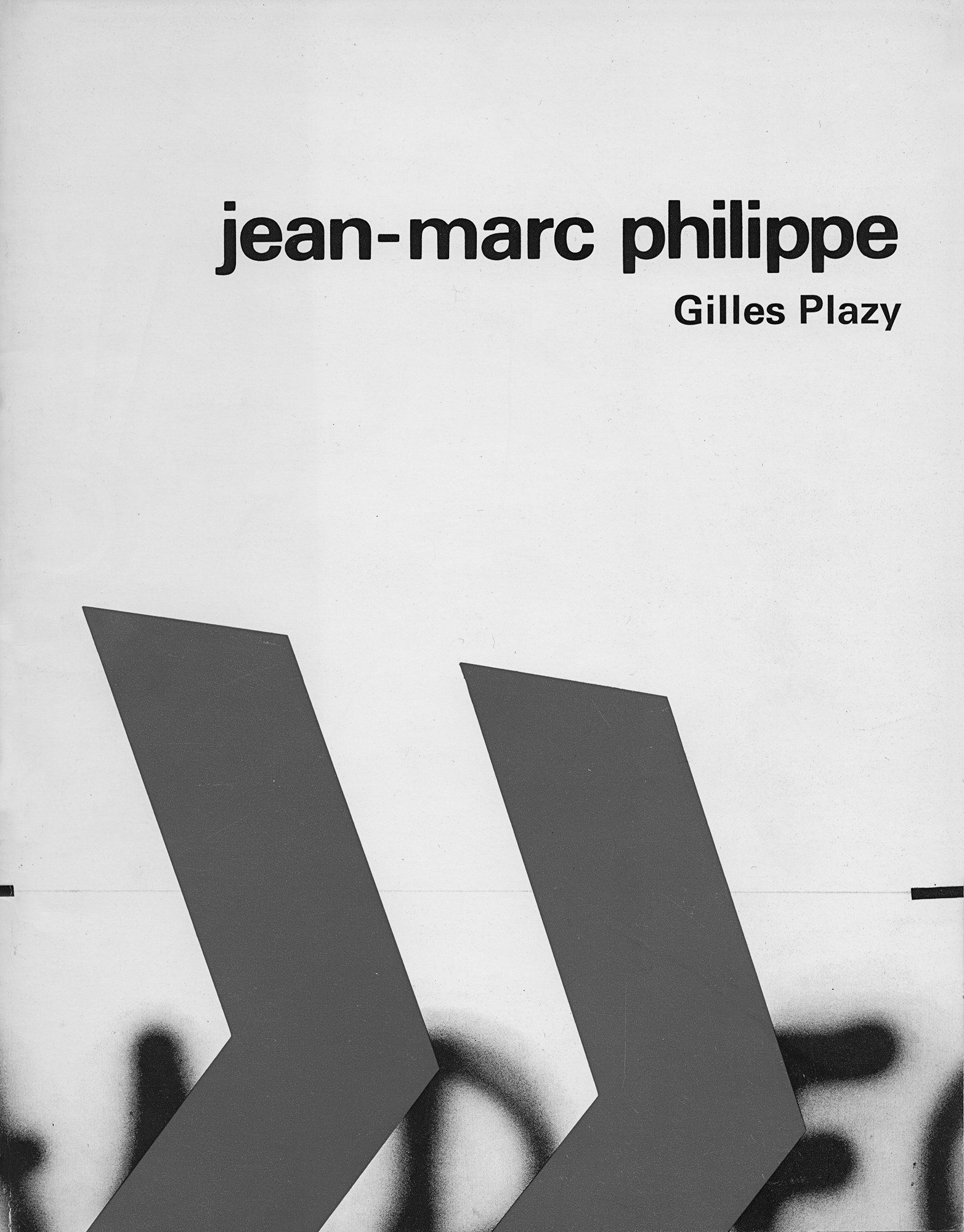
Jean-Marc Philippe (Galerie Attali catalogue)
Gilles Plazy, “Jean-Marc Philippe”, catalogue of the exhibition Œuvres récentes, Paris, Galerie Attali, 1976 (extract from the journal Cimaise).
See: Paintings, Protest Paintings
The text below is the English version printed in the 1976 catalogue.
Original English version (Galerie Attali catalogue, 1976)
Lumping together figuration and abstraction in the name of a generous conception of painting is a very current temptation. But to thus elude an essential difference is a way of maintaining a confusion which contributes nothing to painting.
The last sixty years have sufficiently demonstrated the divergency which gave birth to the two currents, with the result that we no longer shrug our shoulders before what used to be a rivalry between schools. The radical break which gave birth to abstract painting among a pleiad of scattered painters rendered it initially irreconcilable with its figurative elder.
It is possible, in Europe, to like Matisse and Picasso, and also Mondrian and Malevitch, but one cannot, without a bit of legerdemain, make anyone believe that the stakes were the same for these four painters. If Matisse and Picasso open a new chapter in the history of painting, it is within another order that Mondrian and Malewitch inaugurate that which is still painting but something very different from what it was earlier. When te first two, nevertheless, give
two infinite interpretations of the world, the second two invent a new world, open the doors of a new language which is a world in itself.
No longer having recourse to objects or persons, and being satisfied to use a few simple geometrical signs to construct a picture, Mondrian and Malewitch —to take the most evident and most significant of the painters of the first abstract wave—broke with figurative painting, which they had carefully tried first, the way one cuts away at times from a past which can be formative but all of the fruits of which are dead from obsolescence.
This rupture which contains in itself all the liberty of the painting to come is to be decoded as the break which, according to Althusser, marks, in the heart of the works of Marx, the birth of dialectal materialism. Abstraction was not born naturally from Impressionism or Cubism, even though it proceeds from them. It was born of a radical awareness of the nature and the possibilities of painting. And this to such a degree that no painting today can fail to take it into account (unless it is to demonstrate its own emptiness).
Jean-Marc Philippe is a son of the “break.” It was not necessary for him, as it was for so many painters of his age, to cover the distance leading from the figure to the sign and relive the experience of the break. Coming to painting via mathematics and ignoring schools of art, he has lost very little time in vain trials or useless applications.
Painting, to him, from the outset, meant being an abstract painter. It involved no workaday dealing with the subject but an immediate entry into the field of signs. Like numerous painters of his generation, it was the example of the Americans, Rauschenberg and Rheinhardt, which was decisive for him. It is on the other shore of the Atlantic where the second age of abstract painting is in full bloom, and it is in America that he achieves full maturity in his art. Action quite naturally won the day. No doubt the elan of the arm which instantaneously invents form and color, was a response to the rigor of a science made to analyze or construct.
The act of being torn away from too-comfortable patterns of thinking ? The rediscovery of the play of the body ? Jean-Marc Philippe was, naturally, a lyrical
abstractionist, and this spontaneous launching in painting now very often replaces for many artists the impersonal application of schools. Work, questionings, effort, measure follow later—in movement.
The act, too, quickly finds its limits, caught between approximation and repetition. Shoddy spontaneity, ideology of the non-culture of the signs. The dance of the arm in front of the canvas does not prevent one from reflecting upon the raison d’être of painting, to set forth its code.
Jean-Marc Philippe had too great a sense of direction, as André Breton said, to let himself be carried away by the feverish tracery of fireworks. His painting is calm and grave. Vehemence is dissolved in it by the attention given. The cry has found its primal force, not in a din but within the bounds of silence, and graphic freedom confronts the firm virtue of a straight line.
And we find again painting in its second period taking its support from structures of rigorous and simple geometry in which the flat-tint painting takes on depth, and the eye “breathes.” But a trompe-l’œil tear
breaks the line, a break-out fissures the surface, a smudge breaks the rigorousness, an erasure calls back the act, the traces of writing deny the calm expanse of the painting.
From these dialectics, from the full form and from the fissure, from the aesthetics and from the expression, is born the particular tension which is the foundation of this painter’s work. He may very well borrow a wall or a palisade—and by this means bring his art back to the anecdotal—yet the elements which he wrests from the world in order to place them in his painting have more existence as signs than as objects.
Two languages are spoken here within the heart of a same language: the contradiction is dialogue and it is the artist’s privilege to live those contradictions without bad conscience. As for the language, it is the language of Malevitch and Mondrian, of Newman and Rauschenberg, but stripped bare, reinvented, the language which we have gotten into the habit of naming abstraction and which is nothing more than that novelty of the century, painting itself—that art of taking notice, at a glance, of the totality of a world.
Gilles PLAZY
Works reproduced
Titles, dates, dimensions and media as printed in the captions (a caption marked with refers to the full-page reproduction on the following page):
- À Dachau, 1971, 162x130 cm, oil on canvas. Private coll., Athens
- Relique, 65x50 cm, Indian ink on paper
- Image d’un concept, 1972, 146x114 cm, oil on canvas. Coll. R., Paris
- Occultation, 65x50 cm, Indian ink on paper
- XXème siècle-fragment, 150x205 cm, acrylic on canvas
- Rémanence, 65x50 cm, Indian ink on paper
- Dynamique pavlovienne, 1976, 162x130 cm, acrylic on canvas
Transcribed from the original edition (Jean-Marc Philippe archives), reproduced with the consent of the rights holders.