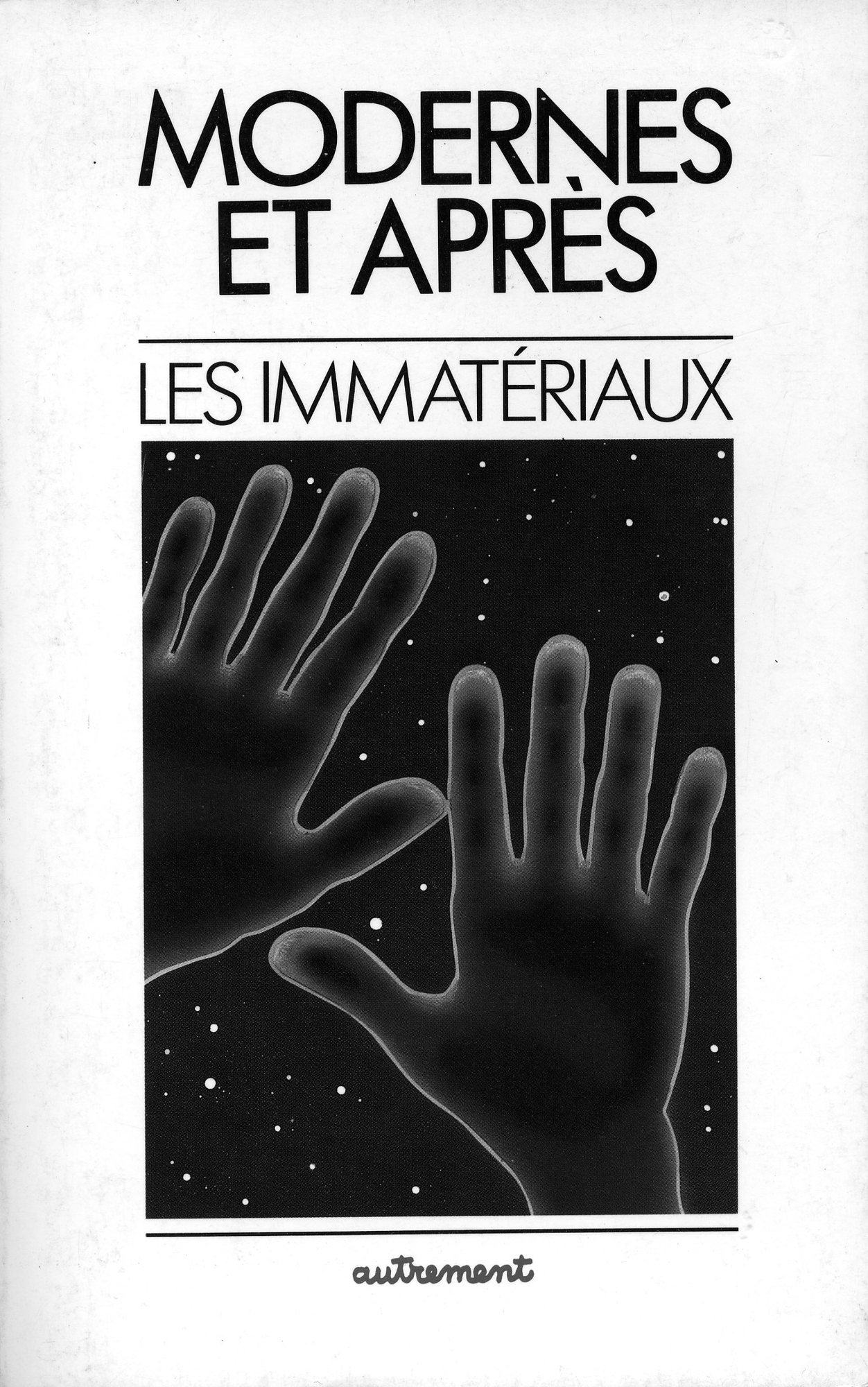
Artistic Invention and its Metamorphosis
in Modernes et après : « Les Immatériaux », Paris, Autrement, 1985, pp. 173-182.
See: Space art, The Great Celestial Wheel, White Works, Paintings, The Variations
p. 173
Artistic Invention and its Metamorphosis
The period our society is going through is not a particularly easy one to live in. Whether we like it or not, we are deluged with endless streams of contradictory information and data which no system of thought can any longer make coherent and, if it is difficult to see clearly, it is even more illusory to hope to remain innocent of what surrounds us.
Moreover, while never, in any human society, has the “décor” been as sumptuous as it is today – and indeed it is – and while it continues to be refined (living environment, life expectancy, social protection), frivolity has overrun us, whereas discourse, for its part, has deserted the stage. Do we still know where the urgent and the important lie? Sometimes. On the other hand, no one any longer, be they artist, poet, jester, philosopher, scientist or economist, knows where the place of the essential is to be found. An empty point, a blind lighthouse, its very metaphor remains gaping. Yet it is precisely because of such a substratum that a rare convergence of privileges is offered to the artist – let me explain.
For artists, an extraordinary opportunity
First, the classical points of reference are collapsing, and no tradition is yet strong enough to hinder or sterilise the imagination. In this moment of depolarisation, everything becomes possible, and the artist's degree of freedom has never been so vast.
Next, we are witnessing a general breaking down of the barriers between fields of knowledge. Knowledge is changing in nature; it no longer lies in the columns of the temple, but between the columns. It is in the interfaces that new seeds meet. The expansion of the systemic p. 174 sciences and the present vitality of the art/science dialogue bear witness to this.
Finally, our time is unique in that, owing to industrial spin-offs as well as to technological know-how, the “Grand Gallery” of artists' supplies goes on expanding endlessly. The artist today enjoys a unique profusion of media of every kind, the very notion of which is constantly broadening. By medium we must henceforth understand any element or device – concrete, theoretical or conceptual – which, closely or remotely, consciously or not, is used in making the work. This encompasses, for example, supports, pigments and materials as much as treatises on musical harmony, mathematical tools, cathode-ray screens, or again the algorithms associated with this or that computerised device, etc.
Now, art proceeds not from the better but from the different, and each new medium brings an unprecedented broadening and extension to the artist's gesture. This does not mean that the expression of this difference cannot be achieved through classical media alone, but one can see that the use of new media eases access to this difference. On condition, however, that one does not fall into the trap of using them merely to show them off in their own glory, when they ought to remain no more than means in the service of an intuition, rather than a simple “trick” of know-how or a demonstration.
Thus the present cultural matrix, because of the three preceding points, could not be more fertile in the conditions most favourable to artistic invention in particular.
However, the spiritual void characteristic of our kinds of society poses a problem and holds invention back: how, upon this void, can one create “inhabited” works – inhabited, in this case, by what? – and how, then, could works be capable of expressing the idea of their own desire? This is no doubt why so many artists today still borrow from their peers the signs of a language already invented, even accomplished, in the wake p. 175
Cosmic horizons opening up: a planetary aesthetic. The Celestial Wheel by Jean-Marc Philippe. p. 176 of which they situate their own approach. These artists remain “merely” repetitive creators, as opposed to others who create but who also invent – sometimes, alas, empty works, in a blind exploration of every possibility – while others, finally, still create but, this time, invent the signs of another language, attuned to a heightened intuition.
Repetition, emptiness or metamorphosis: there, perhaps, lies what is at stake in the art of today.
As far as my own artistic path is concerned, I benefit from this favourable moment and I also try to be one of the active players in breaking down the compartments of knowledge, insofar as I commit myself simultaneously in three directions – and, curiously, this threefold approach heightens the demands I make on each of them.
A white pictorial space
The first of my approaches sees me, by means of classical processes and media in painting, producing canvases in which a representation of the human is organised within a very spare space. The pictorial surface is treated in terms of emptiness and whiteness, of detail and bursting apart, of dispersion and fragmentation, and on it are inscribed identifiable signifying elements: a hand, a gaze, a smile, rather as though the detail as such could reveal the whole of an absent totality, rather as though a certain unnamed empty point corresponded to the centre of gravity of the whole. Such are the 19 Gazes exhibited at the F.I.A.C. 81.
Within this first approach, I resort exclusively to the hand and to that marvel associated with it, touch. But the gestation of these canvases, like their execution, is slow, and, at best, I shall have scattered only a few hundred of them, perhaps, by the end of my life. p. 177
The “imagiques”
The second diretion [sic] in which I am engaged involves the tremendous possibilities offered by electronic techniques of image manipulation, all intervention of the hand being deliberately abandoned. For some years now, scientists, to meet their own needs for visualising the phenomena they were studying, have built devices that remained very rudimentary in terms of aesthetic latitude and potential renderings (devices revealing the movements of the heart in situ or transposing data from remote sensing in space). I was thus led to design original devices that made the field of attainable possibilities more mobile and more extensive, allowing each person's own sensibility to reveal itself in it. The proposals resulting from them have been shown in Tokyo, Milan and, recently, at the Salon Art/Science Phirama in Marseille.
For a painter, such a device is of course somewhat magical for, starting from a chosen proposal (a real shot, a sketch made by hand), several tens of thousands of proposals can be reached, and that within the space of a few hours. These images, escaping all reference, call for a very particular mental approach. The mind encounters in them a raw material as well as a unique practice of experimentation, and the ease of access to this multitude of variations intoxicates the eye and the imagination alike. Moreover, the process of reading and appraising an image destined to be fixed, yet wrenched from its context and turned into a veritable flow of mobile proposals, demands a very keen acuity, the fundamental problem being that of choosing which proposals to retain; an issue all the more interesting in that it calls upon the notion of exclusion as well as that of adherence, which in this case become almost palpable. Whereas in painting the work proceeds far more from “hitting the mark” than from calling upon variations and exploring them systematically within so short a span of time.
These images, the way they are obtained, the logic and syntax p. 178 specific to the device, raise multiple questions for which there is as yet no truly adequate theoretical framework. How, for example, can one explore all the virtually attainable configurations, and does that even make sense....? One must therefore accept the principle of dead ends and either go looking for these images and their variations at random, or methodically visualise a few of them, every “n” configurations, and come back to “zoom in” on those that seem most worthy of interest.
I sometimes find myself thinking of museums of a new kind where the works would be mobile and where dozens of different devices would broadcast, day and night, the endless and never-repeating unfolding of their visual proposals, like the sun playing, in limitless variation, upon the stained-glass windows of an imaginary cathedral.
The Celestial Wheel
The third direction in which I am engaged exalts me even more, and what results from it has nothing whatever to do with anything that pre-exists. There is something in it of a “reasoned” delirium, and this, nonetheless, in a total absence of bounds and limits...
Three times, complex concepts have appeared – ready-made – in my consciousness, as a result appears on a blank page or on a terminal. I know only one thing about them: they corresponded to constant preoccupations that dwelt quietly within me, which intuition, in its immediacy, revealed to me as a spontaneous crystallisation.
One of these concepts aspires to be for the third millennium what the Great Pyramid was in its day. Its name is the “Celestial Wheel”, and it expresses the will to light stars in the sky – but not just anywhere, not just anyhow, nor at just any time. So imagine... “Imagine a crown of stars around a planet, like a great celebration, like something beyond all measure, and yet commensurate with the beings borne by this planet...
“And if the Earth were that planet, if that crown p. 179 of stars were the Celestial Wheel, and if the boundlessness of this Celestial Wheel signified the idea of a new exigency and of difference, as the dawn of the third millennium rises over humanity...”
An aesthetic...
The concept of the Celestial Wheel was born first of all from an emotional shock dating back more than ten years when, one August night, a satellite in low orbit appeared, crossing the celestial vault diagonally before disappearing, swallowed by the cone of the Earth's shadow. That evening, at that instant, the Poem was precisely the entire Universe, and the “I” of the poem that artificial satellite inscribing its trace upon the background noise of the firmament, twinkling like a star of the first magnitude...
At that instant, I knew that science had become subject in discourse. A science and a discourse at the mercy of man, in resonance with his genetic capacities, and through which – at this moment in civilisation – his true measure would be revealed to him, like the story of his destiny.
It was from that night on that I began to hope for a day when man would inscribe no longer the trace but, this time, the sign of his ambition, which would reflect back to him the exigency of this quest.
And it was thanks to the development of space techniques and to technological know-how that this Sign, a mental icon of a new kind, crystallised in its concept and in its form.
In fact, the Celestial Wheel rests essentially on the notion of geostationary satellites in connection with their specific orbit. These satellites, now commonplace in the field of telecommunications, share precise common characteristics: all are arranged on one and the same great circle (lying in the plane of the terrestrial equator) whose radius is equal to seven times the radius of the Earth; once “set” in their orbit (that famous great circle), they remain vertically above the same point on the Earth; they therefore move with an angular velocity strictly equal to p. 180 that of the Earth. Which means that, if a geostationary satellite were visible from the ground, one could go out at any time of the day or night and check that it was indeed still “there”, in exactly the same place in the sky.
In the coming years, the telecommunications market will require the launch of some eighty of these satellites, in addition to the hundred or so already in orbit, which surround the Earth like a gigantic ring of Saturn. The idea, then, was to graft onto the next satellites of this type a technical device remote-controlled from the ground and emitting, on demand, a light signal which, seen from the surface of the Earth, would have a brightness – or magnitude – equal to or greater than that of Venus at its maximum brilliance.
Once thirty to forty of these satellites had been so equipped, they could be switched on by command from Earth, and they would then draw in the sky a gigantic... Celestial Wheel.
And forms...
The whole would then lend itself to diverse lighting configurations. One could, for example, once a consensus had so decided, light them all simultaneously at midnight Universal Time, and at 8:00 and 16:00 UT, for five seconds. Quite apart from the Sign inscribed in the sky, the Celestial Wheel would serve as a time signal and would give material form to the plane of the terrestrial equator (to within a few degrees, that of the plane of our galaxy).
On the occasion of major world events (Olympic Games, World Fairs...), other kinds of lighting configuration could be adopted (making the light signal run from one statellite [sic] to the next in different rhythms, making them twinkle one by one, two by two...), every three hours, for example, thus announcing by a kind of code that somewhere on Earth there is a place of celebration. On Christmas night, all the satellites would shine as a “celestial garland”. And if one day mankind, p. 181 stricken with madness, were to unleash a nuclear conflict, the Celestial Wheel would pulsate, sending out luminous SOS signals in Morse code.
The Celestial Wheel would also make it possible, for the first time, to visualise the speed of light. Light travels at 300,000 km per second, and the circumference of the great circle of the Celestial Wheel measures a little over 280,000 km. So light, running from one satellite to the next, would pass the same point in the sky again a little less than a second later. A further remark is that the Celestial Wheel, depending on the point from which it was observed, would appear at a different inclination to the horizon from one place to another. Thus the evidence that our Earth is round would become perceptible through our travels.
Leaving aside technical descriptions, the practical realisation of the technical system proper still poses a few difficulties. Although the luminous power required is considerable, it is not insurmountable if the duration of a flash of light is of the order of a nanosecond. This requires synchronous stabilisation, but these are questions well known to, and resolved by, specialists in space flight.
Symbolically, my wish is precisely that the “inauguration” of the Celestial Wheel – that is to say its first illumination – should take place only on the first of January of the year 2000, that is, at the beginning of the third millennium. Its financing, finally, could be ensured by a contribution from all the governments taking part, in proportion to their gross national product.
... For the planet Terra
A beacon in space, a sign without precedent, the Celestial Wheel was conceived as a tangible symbol and as a lighthouse revealing our own new dimension as human beings at the dawn of the third millennium: the dimension of our capacity for know-how, of our ability to ask ourselves new questions as well as of our duty to steer a raft of life in p. 182 space, a certain blue pearl in the cosmos, a planet called Terra.
At the crossroads of art, banking and industry, the Celestial Wheel embodies and illustrates the advent of the change of civilisation that lies ahead. Its premises no longer belong to the classical artistic approach, and its realisation involves the whole community. Its financing will be proof that a cultural will has succeeded in bending the traditional nature of investment, going beyond the industrial model alone and becoming applicable, too, to the things of the mind.
For me it represents and expresses the change of scale and of will in human history. And then — perhaps here I am fantasising — I would like it to proclaim the end of the age of prophets, because the prophet is you, is me, because it is now the whole of humanity that is revealed by the sum of all our individual acts, our commitments, our abdications, our aspirations, our demands, and because it is all of this, taken together, that sculpts the true face of the Earth. As I said: I am fantasising... and yet I could believe it: the Celestial Wheel partakes of the Sacred, of which Science — now more than ever — is the subject in this post-modernity that is now beginning...
Transcribed from the original edition (Jean-Marc Philippe archives). © Jean-Marc Philippe / rights holders.