KEO is a project by Jean-Marc Philippe, conceived in 1994: a satellite carrying the messages that the inhabitants of the Earth wish to send to their very distant descendants, intended to return to Earth after 50,000 years in orbit. Jean-Marc Philippe worked on it until his death on 12 November 2008.
The project extends the operation Messages from Humankind to the Universe: in 1986 – 1987, 10,500 messages collected via Minitel were transmitted on 26 January 1987 by the Nançay radio telescope towards the heart of the galaxy. KEO reverses the gesture: the messages no longer travel towards hypothetical others, but towards our own descendants.
The idea
The figure of 50,000 years is not arbitrary: it is the mirror date of the appearance of art, which bears witness to the human capacity for symbolic representation. So dizzying a span of time compels everyone to leave their everyday frames of reference behind and places all the authors of messages on an equal footing. The name KEO is formed from three sounds, [k], [e] and [o], among the most frequent in the most widely spoken languages: it can be pronounced in every culture and refers to no mythology.
Why 50,000 years, why space
In his lectures, Jean-Marc Philippe presents KEO as his response to the contemporary world, torn between splendour and desolation. The human species, which accounts for only 0.4% of animal biomass, has pitted itself against the forces of nature and now finds itself the guarantor and steward of the planet, yet it has forgotten to reflect on its actions. He therefore looks for a metaphor that everyone can share, regardless of culture, religion or age, and that invites each of us to look beyond the span of our own life and consider that of the evolution of the species.
The span of 50,000 years places each of us on the scale of this evolution. The human species appeared some 5 million years ago; the first tools date back at least 2.5 million years, the mastery of fire some 500,000 years, and the first burials, evidence of metaphysical thought, 100,000 years. Around 50,000 years ago, the first signs traced on the walls of Australian caves bear witness to the advent of symbolic thought. Measured against the history of the species, 50,000 years represent only a hundredth of it; but this distance is enough to give KEO's gifts genuine archaeological value.
Why space rather than a buried deposit? Because space speaks to everyone's imagination, and because burying the fresco of messages would have meant choosing a place, a country, whereas space belongs to everyone, or to no one. KEO would face other dangers there, but it would be sheltered from earthly catastrophes: in the event of a calamity, it would become the guardian of this memory of humanity.
“We live in a world today that is dominated by contradictions; at times splendid and at times dismal: splendid and marvelous some days because of the twinkling stars, the beauty of the Earth and the nature, the progress of our knowledge, skills and technology and our capacity to love and give… Dismal and sad some days because of the wars, the murders, the pollution, the disparity between the rich and the poor, the injustice, the torture…”
“I have therefore looked for a metaphor that can be shared by everybody without any distinction of culture, religion and age… a metaphor that incites us not only to go beyond our span of life and time, but also to take into consideration the duration of the line of evolution of our species…”
“From here was born the idea of sending into space a satellite that will return to Earth, safe and sound, carrying all our messages, texts, poems and questions… but a satellite that will return only after a long passage of time…”
“From here was born KEO, a universal invitation to reflect, an invitation to learn more about each other, an invitation to dream about the world and the destiny of our human species…”
Jean-Marc Philippe, extracts from a lecture on KEO (original English text, as quoted in the KEO press kit).
The satellite
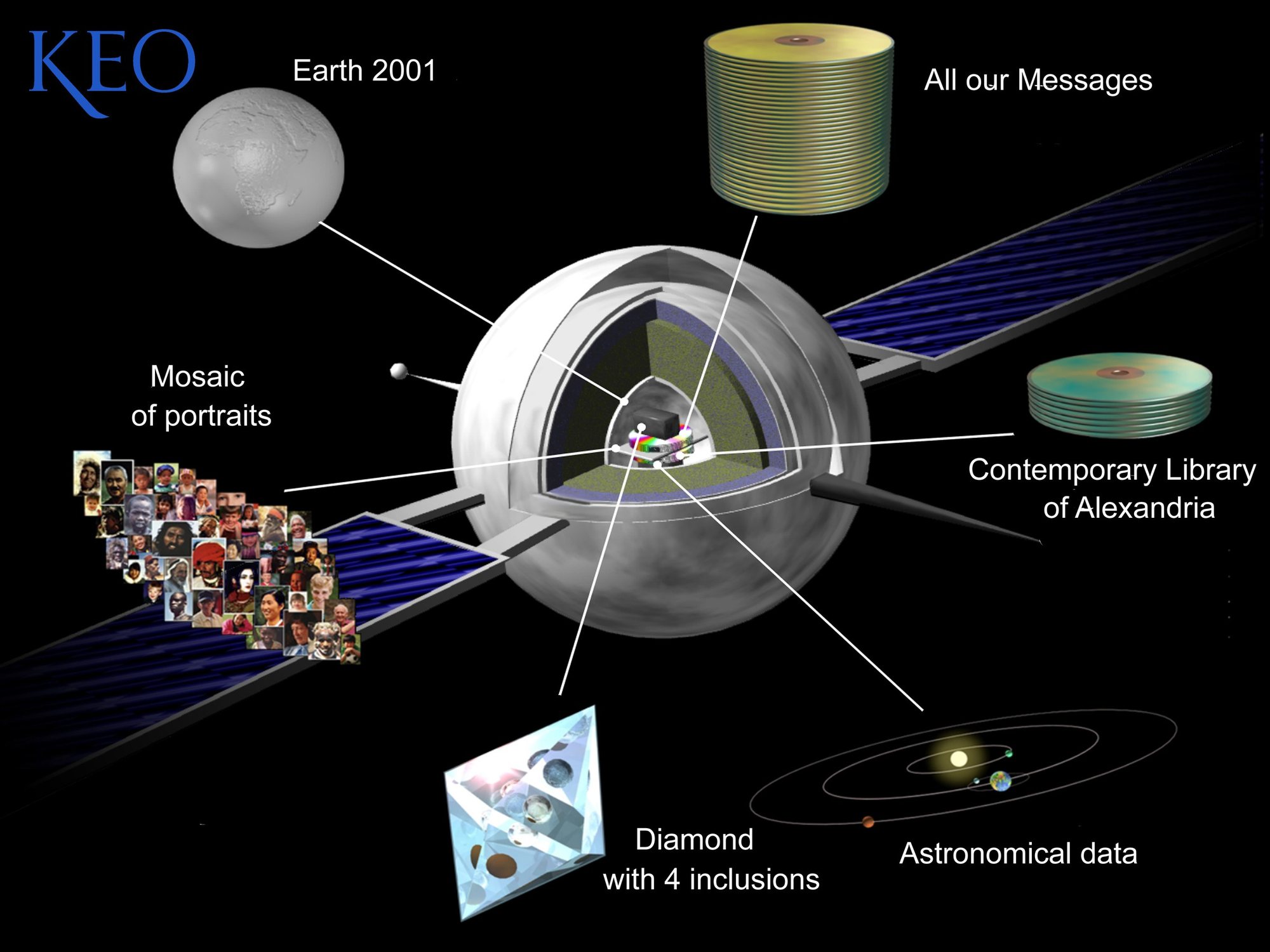
KEO is a titanium sphere less than 80 centimetres in diameter, engraved with an image of the Earth. Two large wings give it a span of 9 metres. Over the course of studies carried out with the French and then the European space industry, its mass was brought down to less than 100 kg, ejection system included. It is passive: no source of energy, no instruments on board. It obeys only the laws of ballistics, the attraction of the Earth, the Moon and the planets, the pressure of sunlight and the drag of the residual atmosphere. At an altitude of about 1,800 kilometres, it would be observable with powerful telescopes.
It was to be launched as a secondary passenger on an Ariane rocket. Folded beneath the fairing, its wings unfold in orbit, then beat each time it passes from the Earth's shadow into the light, thanks to shape-memory alloys and without any energy: they evoke a messenger bird. On its return, KEO would cross the atmosphere protected by several shields (thermal, shock, meteorite and debris, cosmic radiation) made of titanium, tungsten and aluminium separated by vacuum. Shortly before landing, the disintegration of its outer shields would create an artificial aurora borealis in the sky, the signal of its return.
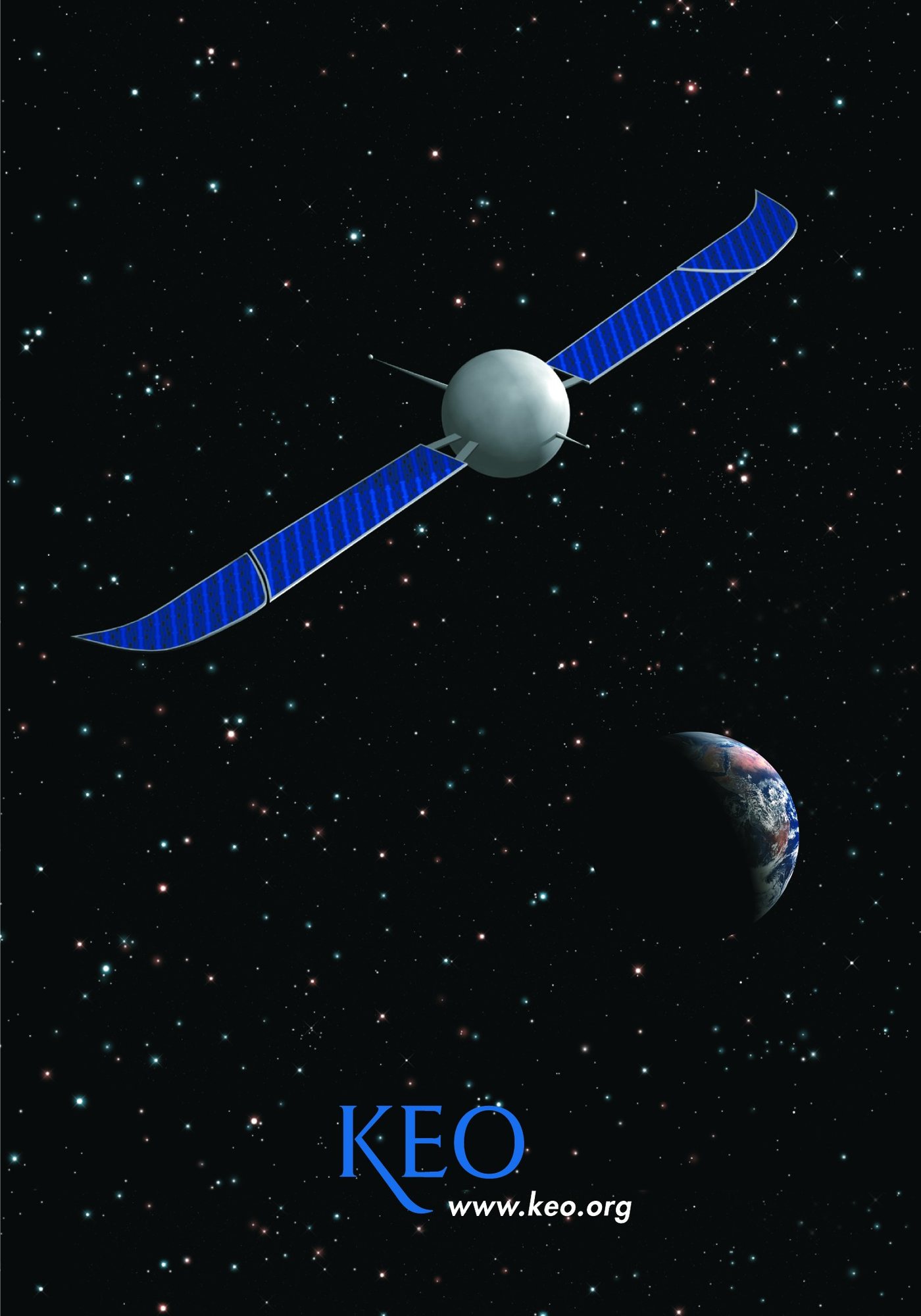
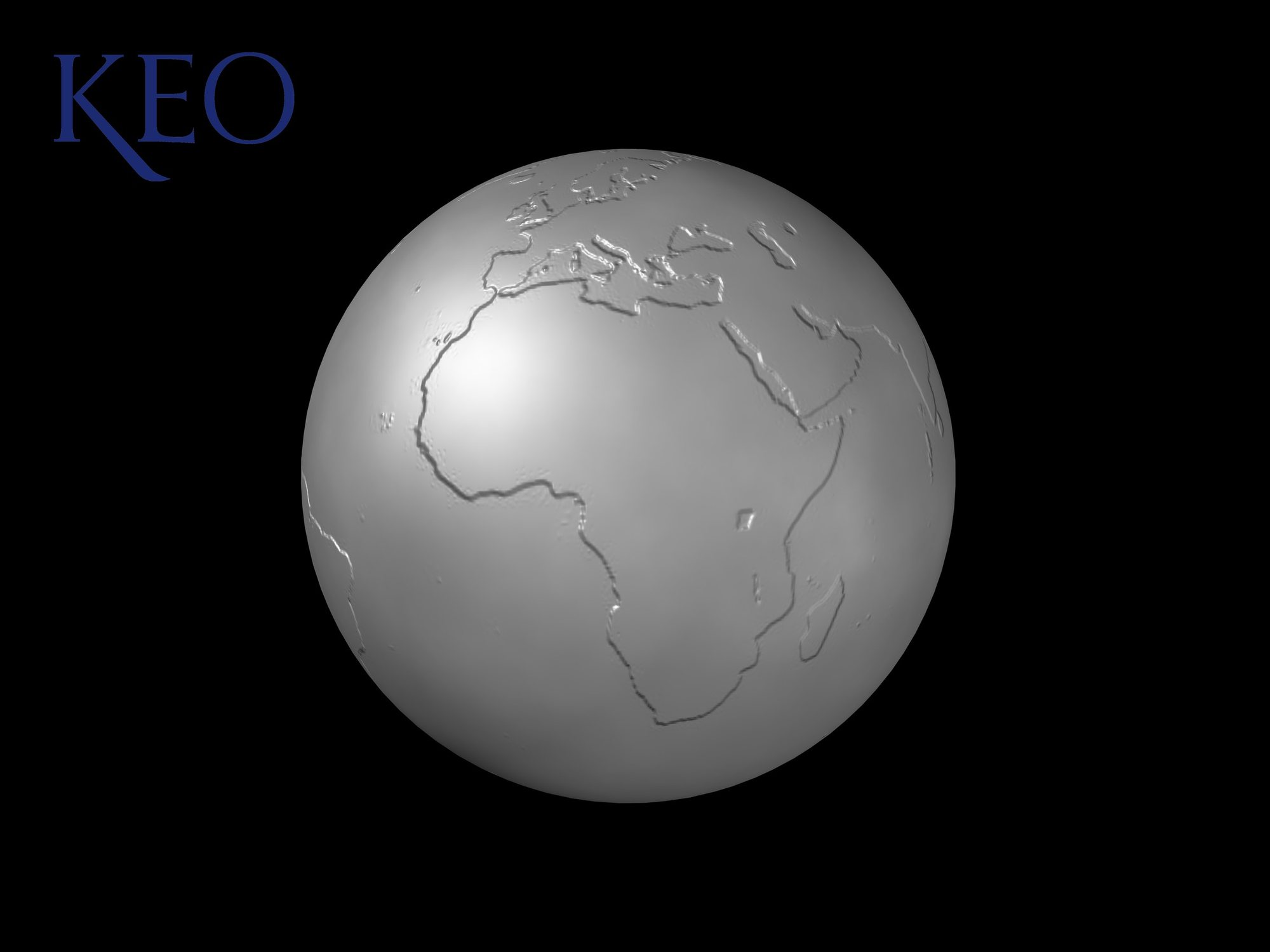
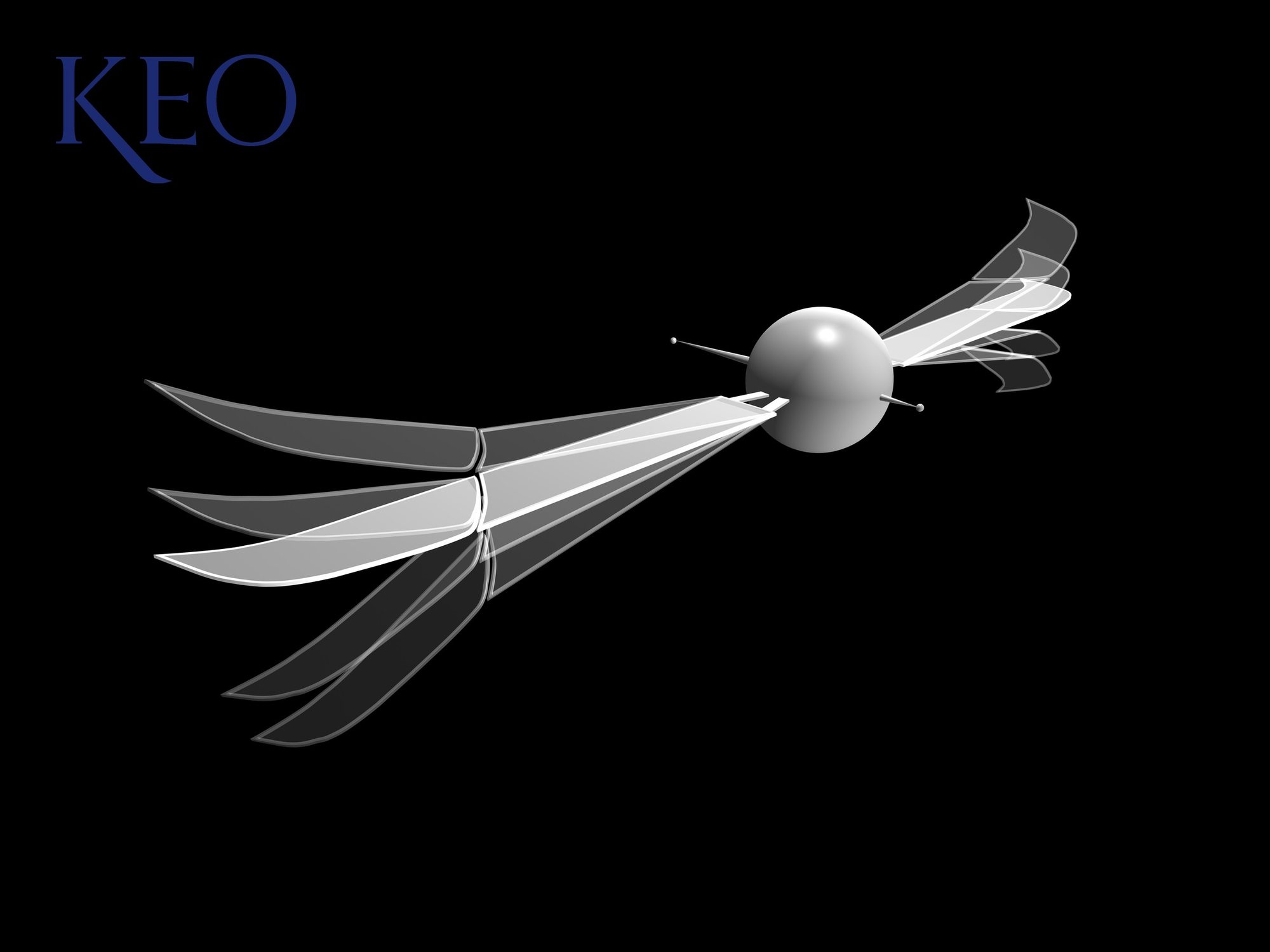
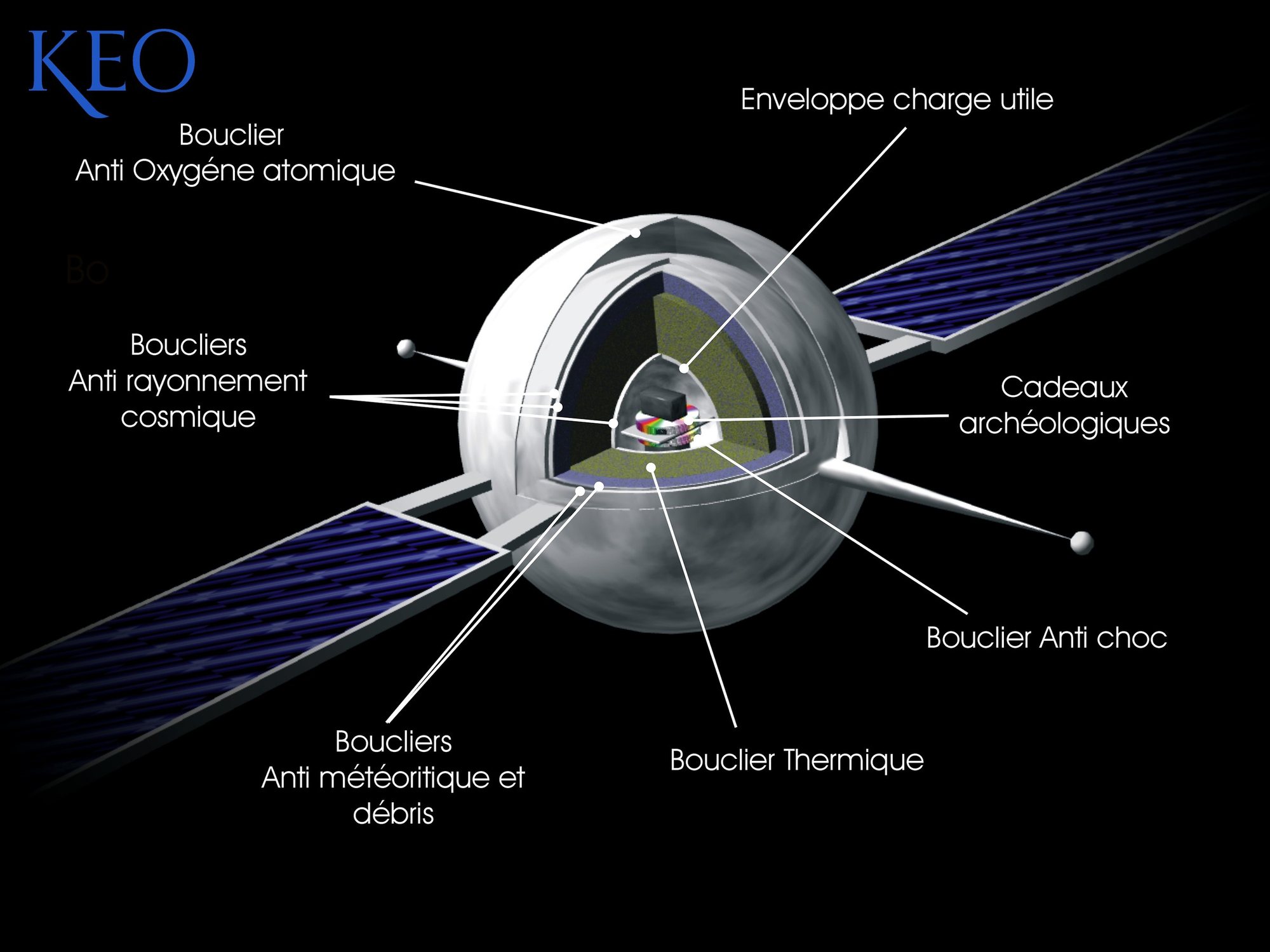
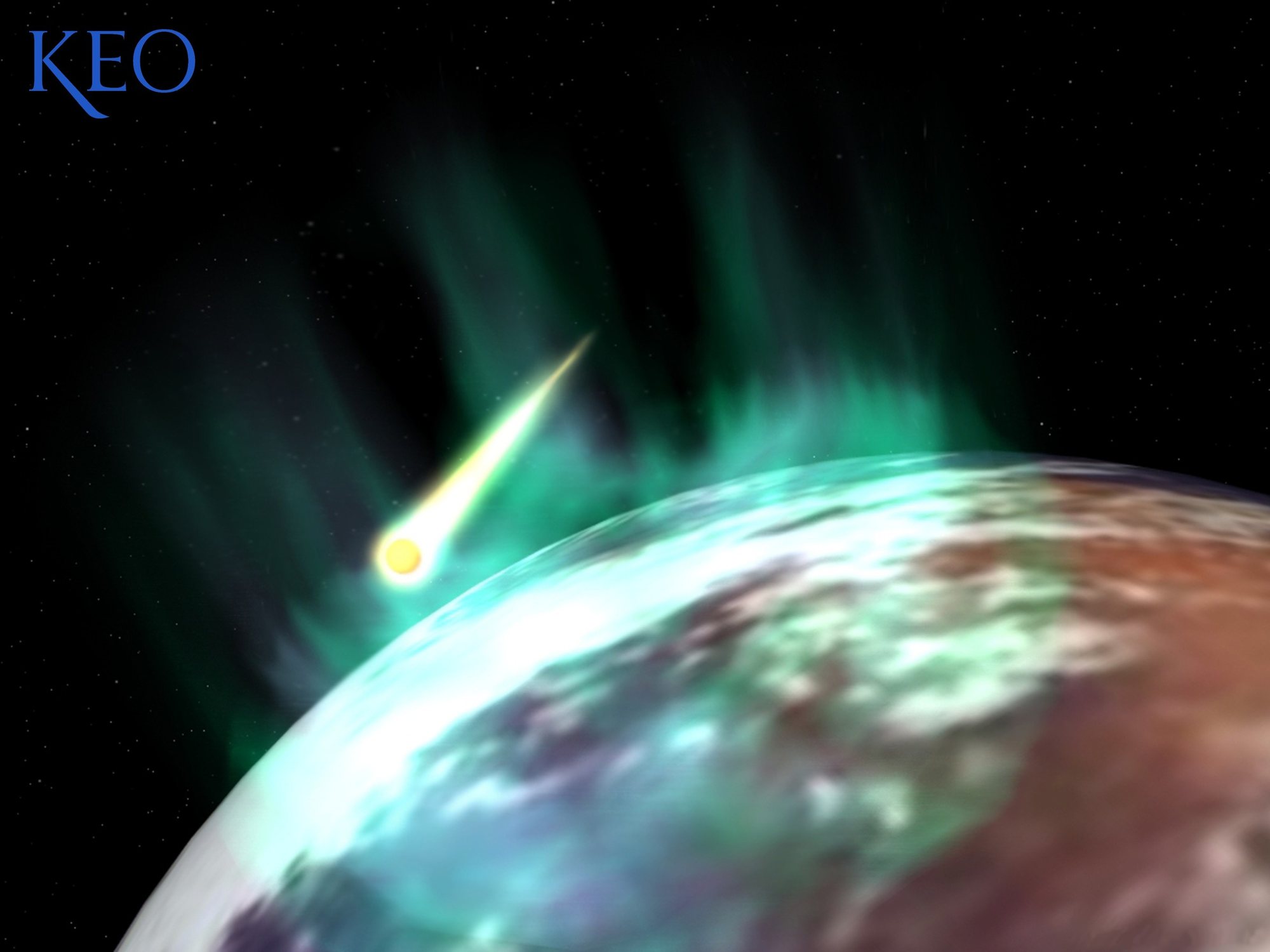
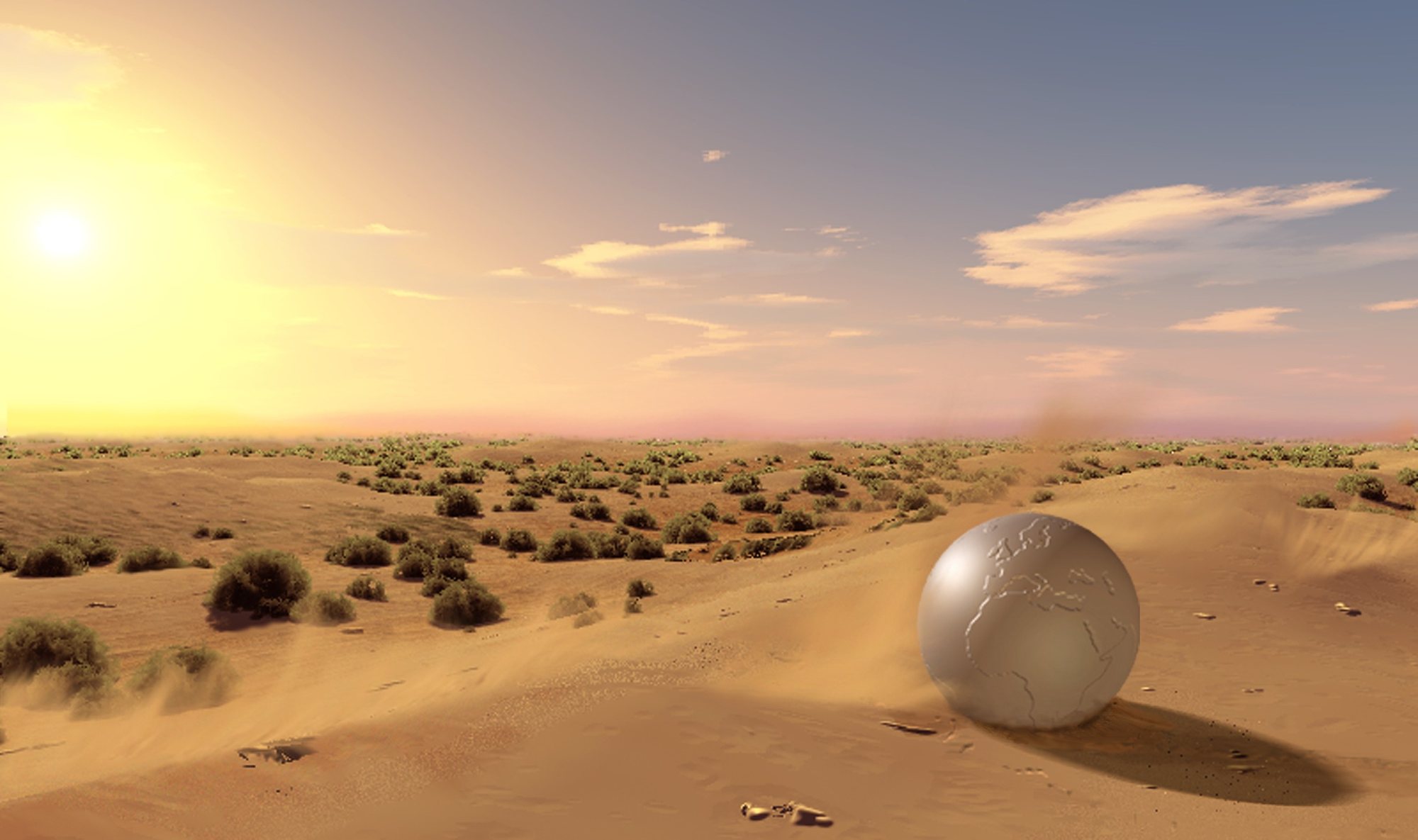
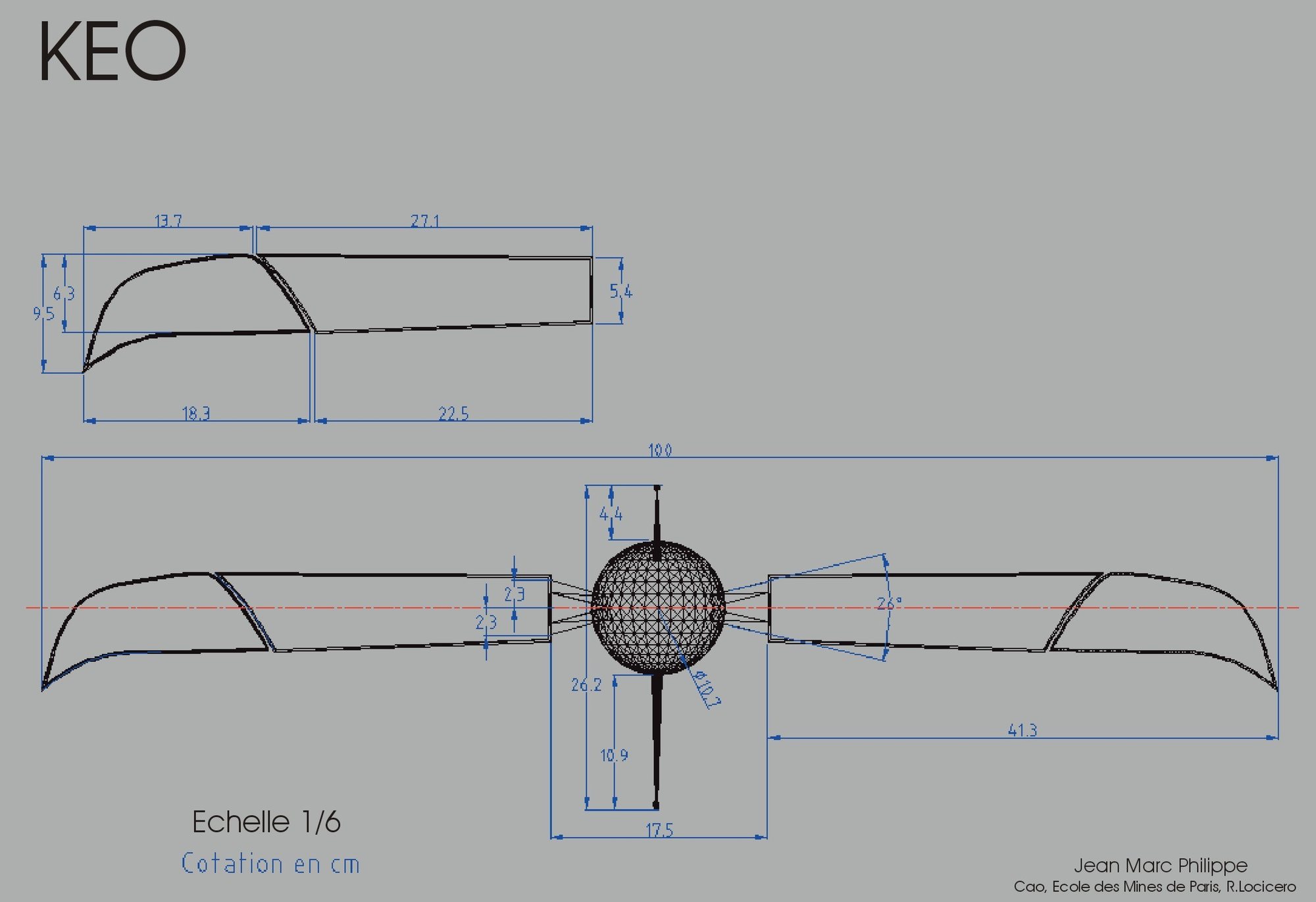
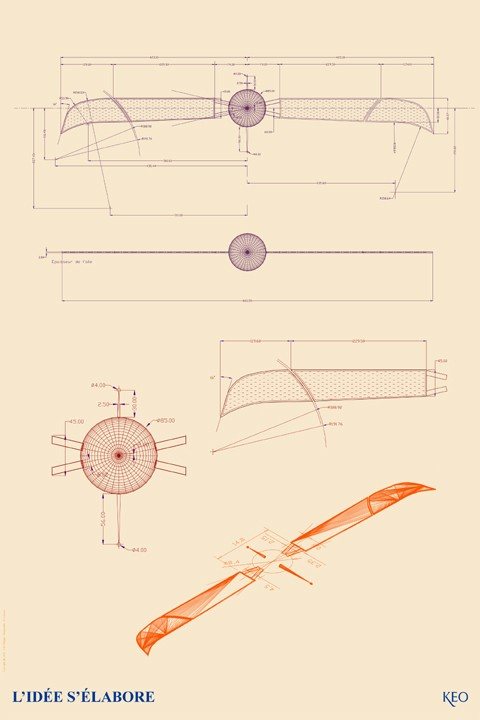
Official images of the KEO project and technical drawings of the satellite.
The journey and the return
Placed in a circular or elliptical orbit, and electrically neutral so as not to disturb the main satellite, KEO unfolds its wings; the press kit specifies that they are released by the sublimation of small naphthalene spheres heated by the sun. They then beat in rhythm with the passages from the Earth's shadow into the light, and a suitable optical telescope could record this flight. Their role is purely symbolic: they make KEO the mythical figure of a messenger bird sent by the people of the 21st century. Unprotected, they come away after a few years, and the sphere continues its journey alone; day after day, its orbit decays and brings it closer to the Earth.
It would not be possible to communicate with KEO: no battery is carried on board, since active materials, whose decomposition is unpredictable, would have threatened its survival. The main danger remains collision with micrometeorites or man-made debris. If space pollution continued to grow by 5% a year for fifty years, KEO would have practically no chance of surviving; its promoters nevertheless considered this risk slight, as the space agencies were already preparing to clean up the orbit.
The return follows a precise scenario. Below an altitude of 120 kilometres, slowed down by the dense layers of the atmosphere, KEO enters the final phase of its flight. Some twenty minutes before landing, it appears as a shooting star, brighter than a natural star, with a continuous, intense glow. Two minutes before touching the ground, its titanium and tungsten shields disintegrate under the accumulated heat, while its carbon heat shield rises to 2,800 °C; ionisation releases a stream of fine luminous particles. At the heart of the sphere, the temperature must not exceed 450 °C (480 °C according to other passages of the same documents). Metal-foam shields absorb an impact at speeds of up to 130 metres per second; in the event of a splashdown, a spherical casing of titanium, chosen for its ductility, keeps it afloat, the payload being less dense than water.
The stages of feasibility
The technical files trace the stages of the design:
- 1992 – 1994: the project is fully conceived and described. The payload must stay below 280 °C and offer enough memory for every inhabitant of the Earth to have their four pages.
- 1995 – 1997: after two years of studies with Aérospatiale and Sup'Aéro, a first feasibility demonstration is carried out in June 1997; the mass of the satellite is then set at 200 kg.
- 1997 – 1999: to meet Arianespace's requirements, the engineers of Aérospatiale Matra bring the mass down below 100 kg, which allows it to be launched as a secondary satellite on any rocket of the Ariane family.
- October 1998: the results of the GANIL experiment are presented at the 49th International Astronautical Congress in Melbourne.
- 2000: the technical partners announce that the glass discs will be able to withstand 480 °C.
- 2001 – 2002: engineers from Arianespace, Astrium, CNES, EADS and Sup'Aéro redefine the dimensions of the satellite.
- 2004: responsibility for the industrial definition passes to the European Space Agency, which concludes in favour of a passive satellite of simple design, weighing about 100 kg (of which 70 kg for the satellite and some ten kilos for the ejection system), that could be built within twenty-four months of the decision to manufacture it.
The materials (titanium, glass, carbon-carbon composite, ablative materials, metal foam) were chosen for their resistance to time and to the extreme conditions of space. The CEA developed the shape-memory alloy joints and the micro-inclusions of the archaeological gifts; Intespace carried out the wing-deployment tests.
The archaeological gifts
KEO carries several sets of objects, designed to be discovered and then deciphered:
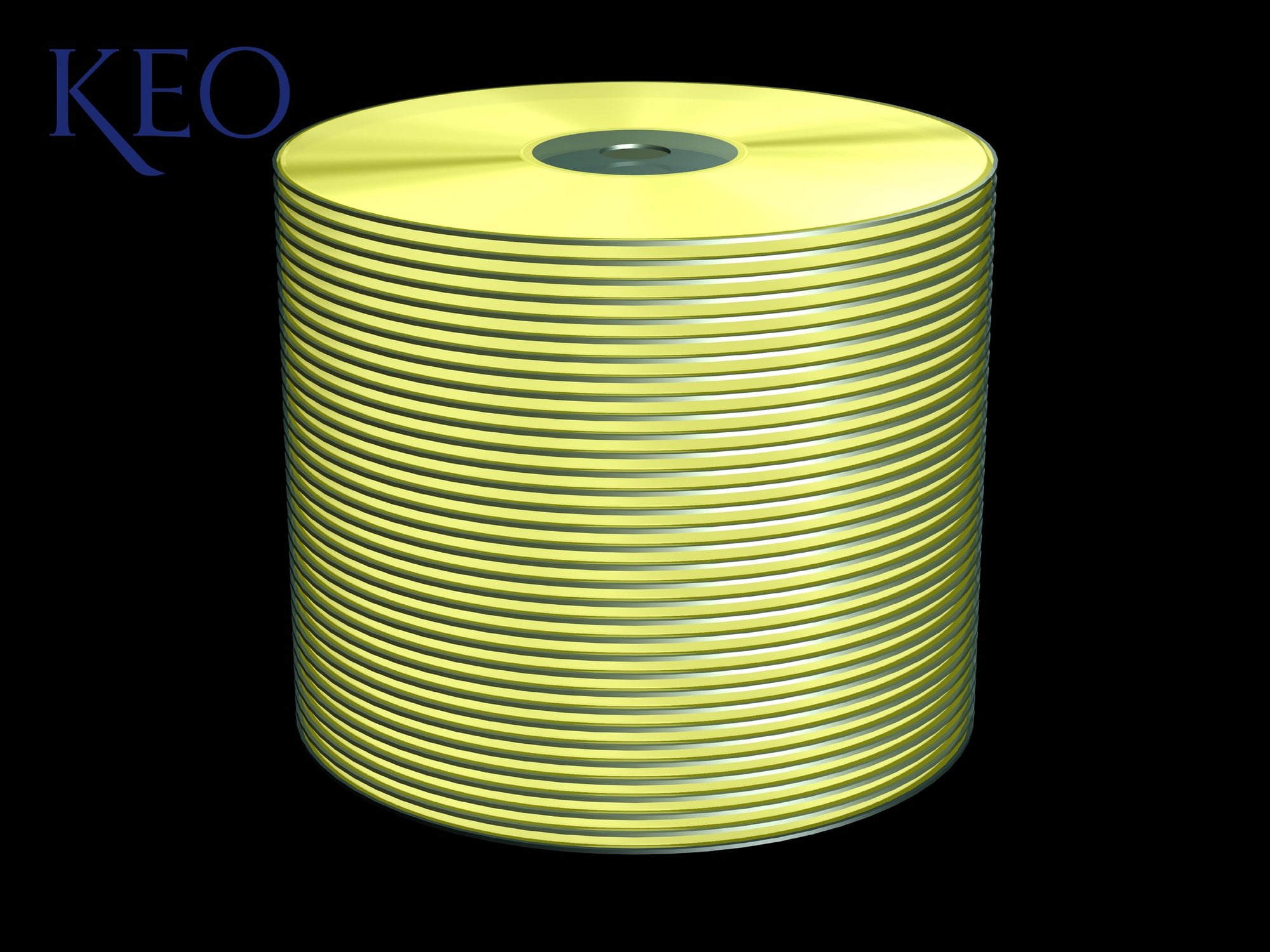
- a stack of laser-engraved glass discs bearing the messages of the inhabitants of the 21st century;
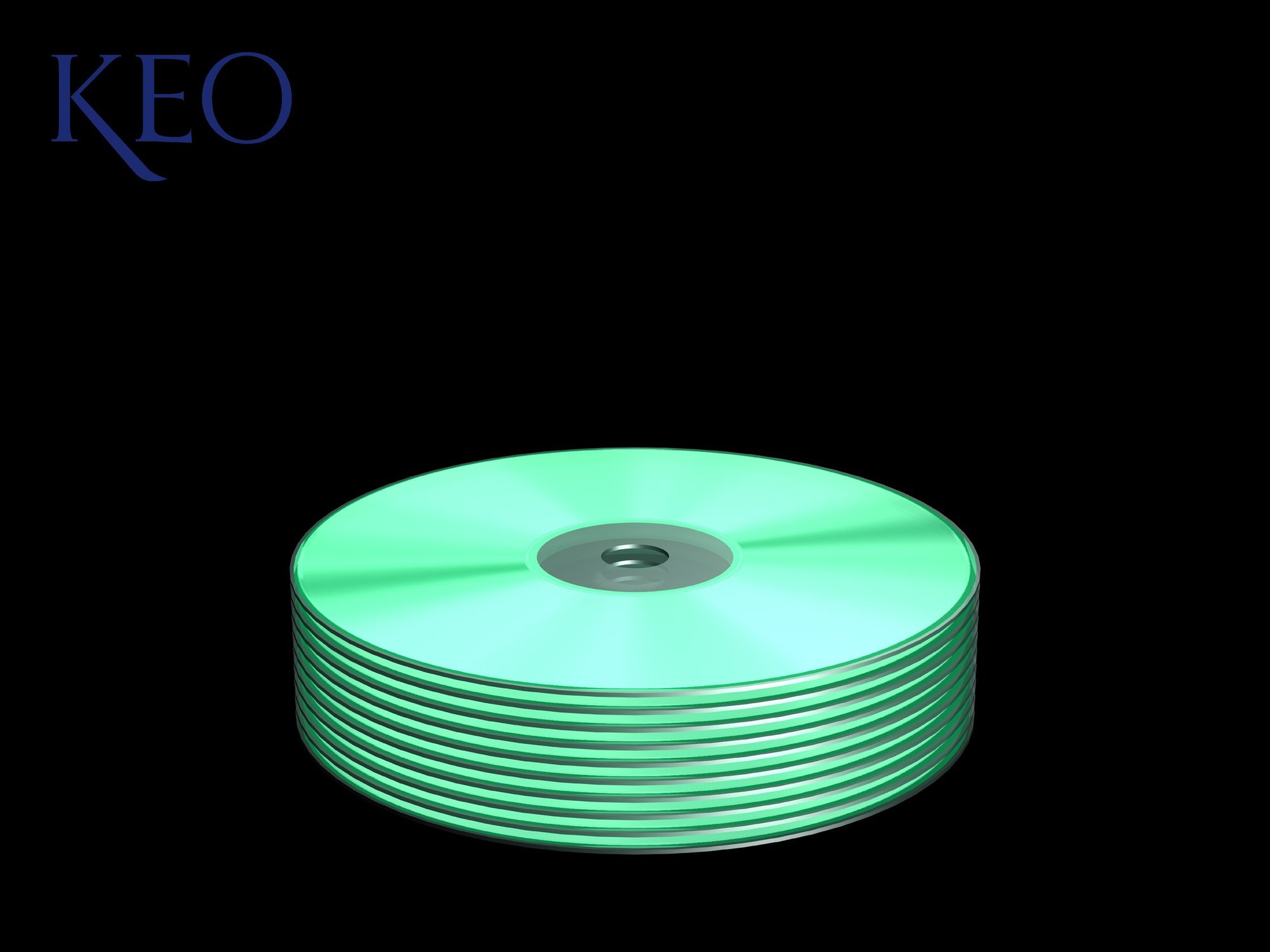
- a second stack, the “contemporary Library of Alexandria”, a record of the knowledge of our time (arts, learning, traditions, geopolitical situations) in texts, images and sounds;
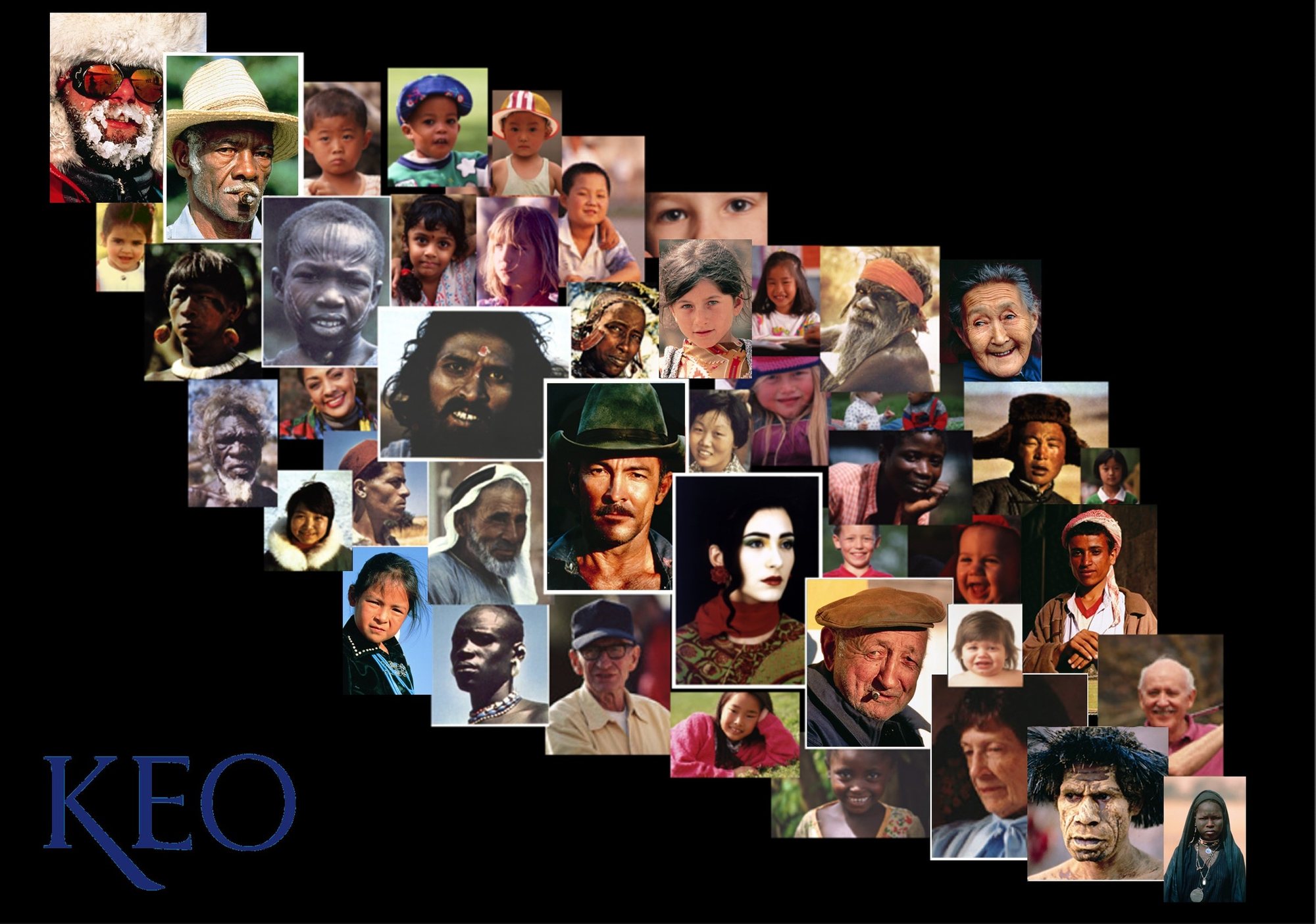
- a mosaic of the faces of men, women and children, with a sequence of human DNA;
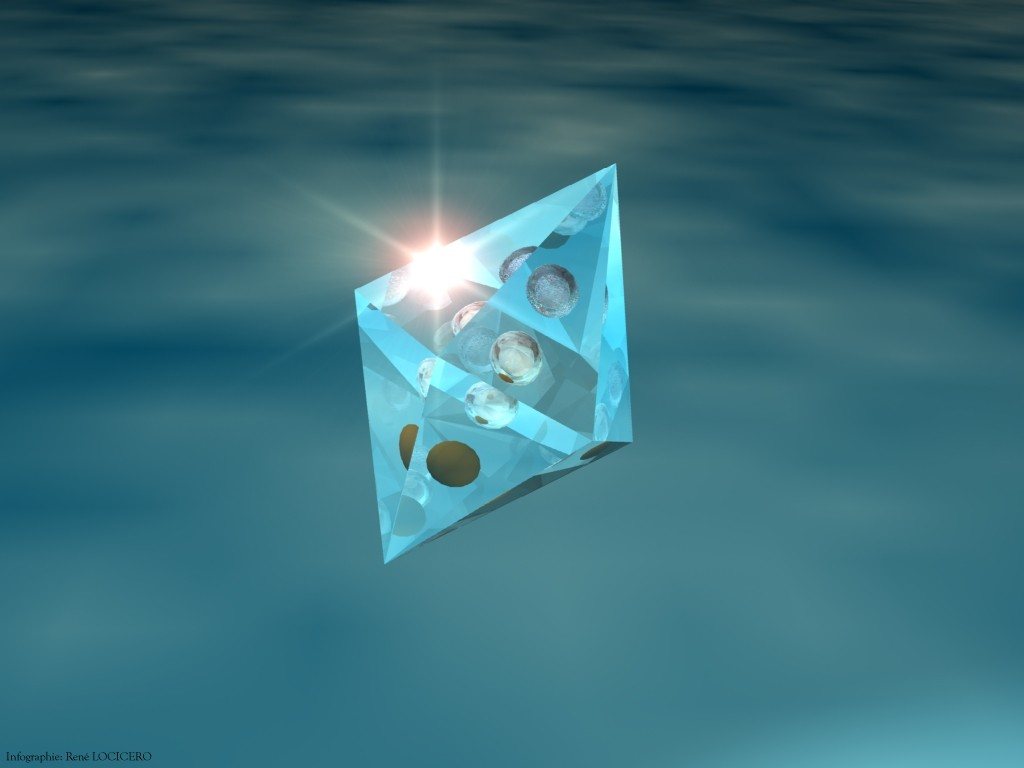
- a diamond with four inclusions of gold spheres: water, earth, air and a drop of human blood;
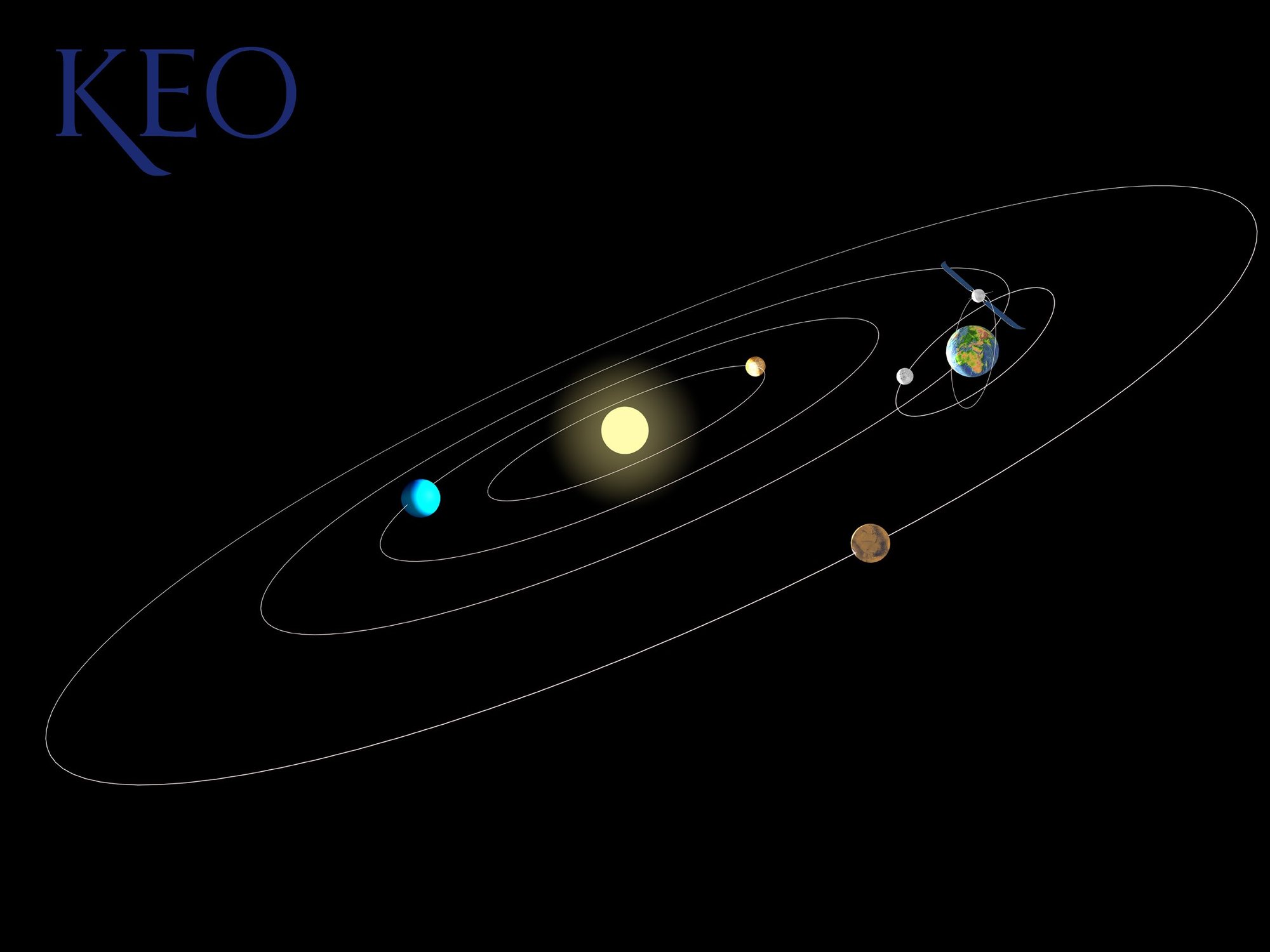
- a sidereal clock fixing the position of the planets at the moment of launch, so that it can be dated;
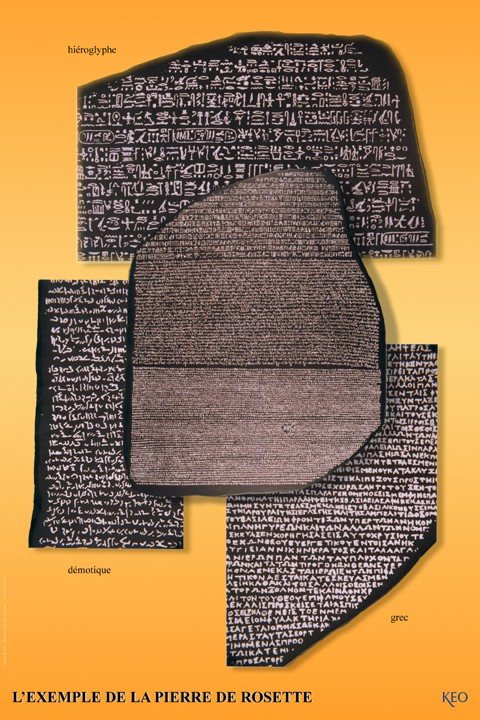
- reading keys: instructions in symbolic terms for building a disc reader, after the example of the Rosetta Stone, and a disc to be read with a tuning fork.
In July 1998, at GANIL in Caen, the discs were exposed to the equivalent of 50,000 years of cosmic radiation: they remained intact.
How our descendants would decipher them
The Earth engraved on the sphere would signal to those who discover it that this strange object fallen from the sky is meant for them; it would show the present outlines of the seas and continents, which changes in the climate and continental drift will have altered.
The mosaic of faces, engraved on a glass plate, would bear witness to a human diversity that time and intermixing may have blended together; the DNA sequence poses a question: will our species change in its turn? In the diamond, what is more precious than the stone is the water of the oceans, the pinch of fertile soil and the air of the atmosphere, which make life possible in their present composition; the drop of blood, taken at random from among the different human groups, symbolises our common genetic signature. The sidereal clock would make it possible to date the launch, since the same configuration of the planets recurs only once every 200 million years.
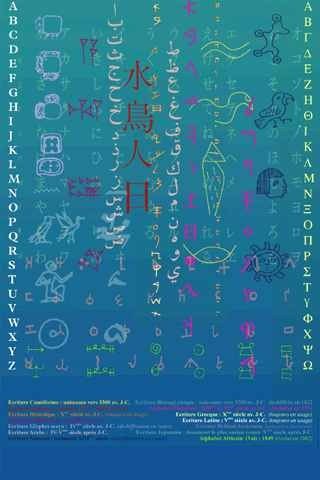
To guide the reading, some 200 immediately intelligible drawings, diagrams or holograms would be engraved on the faces of the discs, together with invariant signs used by many civilisations, such as water or the house, translated into several languages. A disc engraved in analogue form, like an old vinyl record, would be accompanied by a tuning fork, a miniature horn, a needle and a diagram showing how to turn it: as soon as the frequency emitted by the horn matched that of the tuning fork, one would hear human voices speaking the main languages of today and music of our time. The next disc would carry the same information, digitally encoded and engraved: the deciphering could begin.
A laser reader, too bulky and too fragile, could not be carried on board; diagrams engraved on several discs, repeated in the manner of the Rosetta Stone, would explain how to build one in order to access the texts and images, which are invisible to the naked eye. The content of the contemporary Library of Alexandria was to be established by a multicultural and multidisciplinary committee of sages; images and sounds, excluded from the messages, would find their place there. How long would it take to decipher everything: a day, or a thousand years? The authors of the project acknowledged that we would never know.
The messages
Every inhabitant of the Earth could write a message to KEO, free of charge, in the language of their choice, from a single line up to 6,000 characters, or four pages: “four pages of freedom and equality”. Only texts were accepted, so that no one would have more means than anyone else, and there was no censorship. Messages were sent by Internet or by post; those who cannot write could dictate their message to someone close to them, and volunteer collectors, the Keonauts, gathered those of oral cultures.
After the launch, the messages were to be made anonymous, then made freely accessible and analysed, country by country, age by age, language by language, in order better to understand what the humans of today say about themselves.
Writing to one's descendants
The message could describe one's way of life, one's dreams, hopes and revolts. But the distance of 50,000 years transforms the exercise: in writing to KEO, everyone speaks freely about themselves and at the same time sees themselves in a new light. The files list the questions that such a message brings to the surface, even without putting them into words: the meaning of life and death, of the family and of the human family, of individual and collective responsibilities, the responsibility of the species towards itself, towards other species and towards its planet. For our behaviour today will decide what our descendants will be and what environment we leave them.
So that these descendants would know the authors, each message was accompanied by a few details: sex, date of birth, nationality, country of residence and country from which it was sent, language of the message and mother tongue; name, address, profession and leisure activities were optional. Each message was to be preserved in the language chosen by its author. Taking part cost only the price of an Internet connection or a stamp; those without personal access could go through a friend, an Internet café, a library, their school or the town hall. For those who cannot write, KEO counted on solidarity: a child who had heard about the project at school could transcribe the message of his or her parents or grandparents.
The presentation files reverse the perspective: what would we not give to receive messages from the inhabitants of Lascaux? Until now, only the powerful (pharaohs, rich merchants, jurists, saints or poets) have been able to pass on their thoughts. With KEO, the hundred thousand builders of the pyramids, like the soldiers of Genghis Khan, would have had a voice, and our view of history would have been changed. The project was thus conceived as a gift of posthumous friendship, and even a gift of love, addressed to our distant great-grandchildren.
A present for today
If KEO is a gift for the future, its real interest, according to its promoters, lay in the effect it could have on the living. A copy of the messages was to be kept on Earth and, once anonymised, made freely available on the Internet, under protocols designed to prevent any unethical use. Everyone would have been able to read the words of others, and first of all of those who are never heard: the chief of the savannah, the child of the shanty towns, the patriarch, the mother of a family, the girl in love, the young unemployed man, the Nobel laureate, the famous poet.
Natural language processing tools were to make it possible to map this corpus, and the results would be communicated to the media, schools, NGOs and governments. After the launch, a KEO Foundation was to continue this work and open a worldwide debate around three questions: who are we, what can we expect of ourselves, what future do we want to build together?
An undated presentation outline written in French, preserved in the archives, announces “already 1 million messages” and proposes to “launch queries by interrogating the corpus of messages”, to “feed public, political and educational debate” and to “use the messages as spokespersons for the peoples”.
A worldwide collection
From 1997 onwards, Jean-Marc Philippe and the KEO Programme association presented the project at congresses, exhibitions and collection campaigns in France and around the world. The education ministries of several countries circulated a teaching guide translated into eleven languages. Messages came from more than 200 countries; at the beginning of 2007, China led in the number of messages, ahead of the United States, India, Canada and Mexico, and Réunion Island in the rate of participation.
Chronology
| 1994 | Paris — Jean-Marc Philippe completes the formulation of the idea of KEO. |
|---|---|
| May 1997 | Paris, UNESCO — Exhibition “Les sciences dans l'art”: first presentation of the model of KEO. |
| October 1997 | Turin (Italy) — 48th International Astronautical Congress: presentation of the feasibility study. |
| 1998 | Paris, Cité des sciences et de l'industrie — Exhibition (20 June – 1st September). |
| July 1998 | Caen, GANIL — The glass discs are subjected to the equivalent of 50,000 years of cosmic radiation: they remain intact. |
| 1999 | Toulouse, Cité de l'espace — Opening of a permanent exhibition (14 May). |
| 1999 | Vienna (Austria); New Delhi (India); Paris, UNESCO — Model presented at UNISPACE III (UN), at the Space 99 fair and at the exhibition “Partenariats pour le XXIe siècle”. |
| 2000 | Hanover (Germany); Brussels — World Expo, French pavilion; “Prélude à l'envol de KEO”, Brussels Town Hall, French presidency of the European Union. |
| December 2000 | Paris, UNESCO — Evening event “Postésie 2000, du Vélo à KEO”, devoted to the safeguarding of languages around a poetry competition. |
| 2001 | Athens and Delphi; Asunción (Paraguay) — World Poetry Day (Cultural Olympiad); day of message collection at the French Embassy. |
| 2001 – 2003 | Quebec City (Canada), Musée de la civilisation — “Prélude à l'envol de KEO”: an exhibition of about 1,000 m², produced with the Musée du Louvre, which lent 51 works. |
| March 2002 | Réunion — The teaching kit is distributed to every school. |
| September 2002 | India: New Delhi, Calcutta, Chennai, Bangalore, Hyderabad, Bombay — Presentation tour, press conferences, schools and universities; posters measuring 15 by 5 metres in Bombay. |
| July 2003 | Paris — Analysis of a sample of 100,000 messages by the company Lingway. |
| September 2003 | Plovdiv (Bulgaria) — A 400 m² exhibition at the International Technical Fair: more than 21,000 visitors. |
| 2004 | Strasbourg; Dakar (Senegal); Belgium, Euro Space Center — Presentation at the Council of Europe; study trip to Senegal; exhibition at the Euro Space Center (2004 – 2006). |
| December 2004 | Beijing (China) — Formation of the KEO China Committee. |
| February 2005 | Tehran (Iran) — Press conference, television programmes; teaching guide translated into Farsi. |
| May and September 2005 | Alexandria and Cairo (Egypt) — Lectures at the Bibliotheca Alexandrina; launch of the campaign towards the Arab world and first poster in Arabic. |
| June 2005 | Vienna (Austria), UN — Presentation before the Committee on the Peaceful Uses of Outer Space, at the invitation of ESA and Belgium. |
| November 2005 | Brussels — “Fête du Roi” (King's Day) devoted to space, at the Palais de la Nation. |
| Dec. 2005 – April 2006 | Mexico City, MUTEC — A 500 m² exhibition, opened on 7 December in the presence of Jean-Marc Philippe: 2,000 to 3,000 pupils a day. |
| January 2006 | Damascus (Syria) — Press conference at the National Museum; the exhibition planned for the spring is cancelled because of the war in Lebanon. |
| 2006 | Beijing; Tehran; Mexico City — Campus activities by the KEO China Committee; stands during Space Day in Tehran; schools and the Human Rights Fair in Mexico City. |
| 2007 – 2008 | Mexico: León, Mexico City, Pachuca — Exhibitions at the Explora museum (León), in the “Tunnel of Science” of the Mexico City metro (about 100,000 visitors a day) and at the El Rehilete museum (Pachuca), with messages from the Hñähñu community. |
| 12 November 2008 | Death of Jean-Marc Philippe. |
| April 2009 | Malmedy (Belgium) — Operation “Who Are You?”: more than 250 children write their message. |
| 22 November 2012 | Paris, UNESCO — Presentation of KEO; the International Fund for the Promotion of Culture announces that it is taking up the torch. |
| December 2013 | Guyancourt, lycée de Villaroy — A message urn placed beneath the spiral clock designed by Jean-Marc Philippe. |
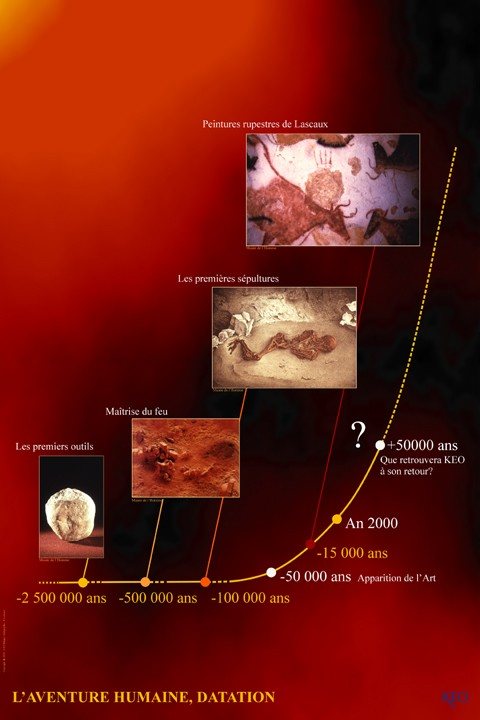
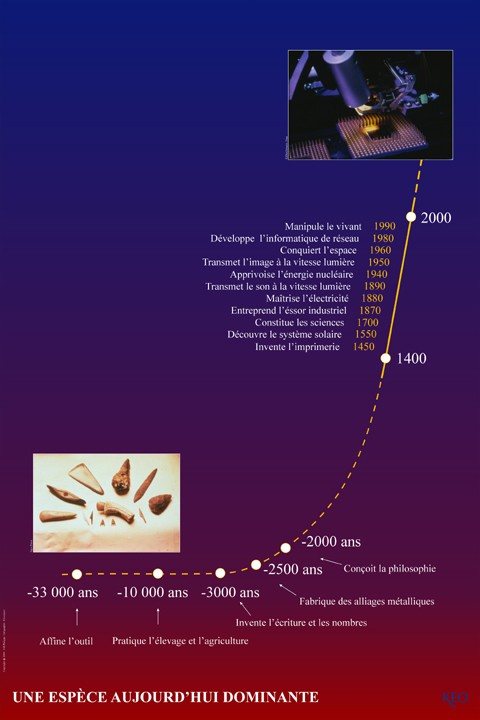
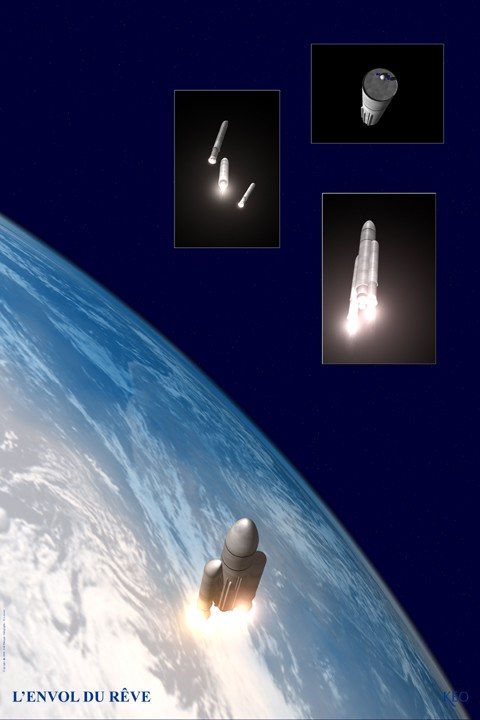
Panels from the KEO catalogue and exhibitions.
KEO at school
As the project became better known, teachers took it up as a basis for interdisciplinary work, at the crossroads of science, technology, art and philosophy. Their experiences gave rise to a teaching kit: a guide presenting the satellite, its archaeological gifts and ideas for the classroom; a CD-ROM of royalty-free images; five posters; a video cassette made by pupils of the Robert-Doisneau school in Corbeil (Essonne), with a seven-minute film on the odyssey of KEO; and twenty postcards explaining how to send one's message. At the end of 2002, the project received the support of the Centre national de documentation pédagogique.
The kit aimed to help pupils understand the world by questioning it in a different way, to exercise their critical faculties and to realise that they are already the ancestors of their great-grandchildren. Teachers' accounts describe its effect: in Réunion, a primary-school teacher relates that KEO taught their CE2 pupils (eight- and nine-year-olds) to dream, the class feeling that it was taking part in a project both real and magical; in Montreal, a chemistry teacher maintains that after KEO you no longer see your pupils in the same way, and neither do they.
UNESCO
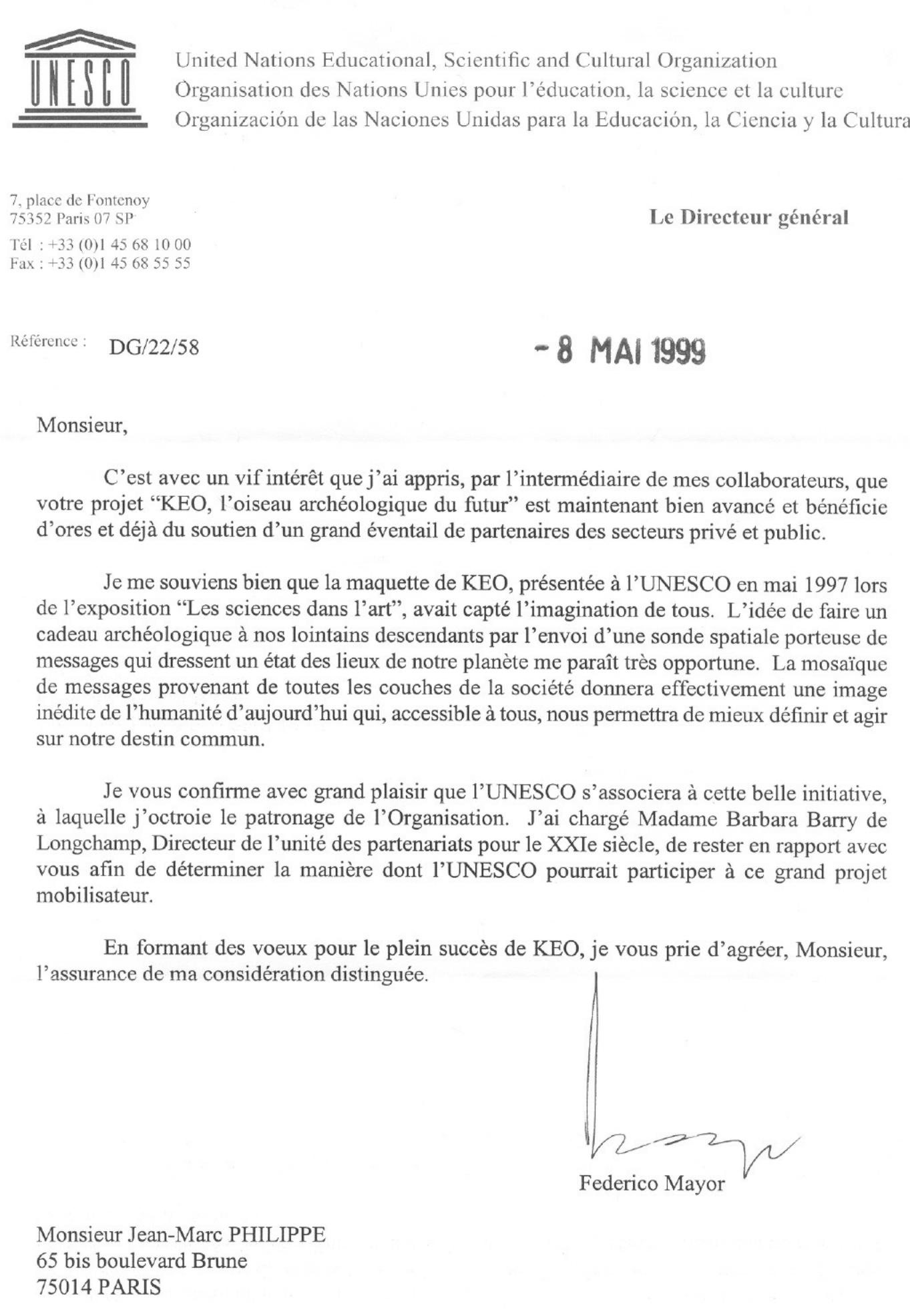
On 8 May 1999, Federico Mayor, Director-General of UNESCO, granted KEO the patronage of the Organization: “The idea of making an archaeological gift to our distant descendants by sending a space probe carrying messages that take stock of our planet seems to me most timely.” He had discovered the model in May 1997, at the exhibition “Les sciences dans l'art”, and selected KEO as a “21st-Century Project”.
Patronage
In the text he contributed to the press kit, Federico Mayor sees in the mosaic of messages, coming from every stratum of society, an unprecedented image of today's human community which, accessible to all, will make it possible to define our common destiny and to act upon it.
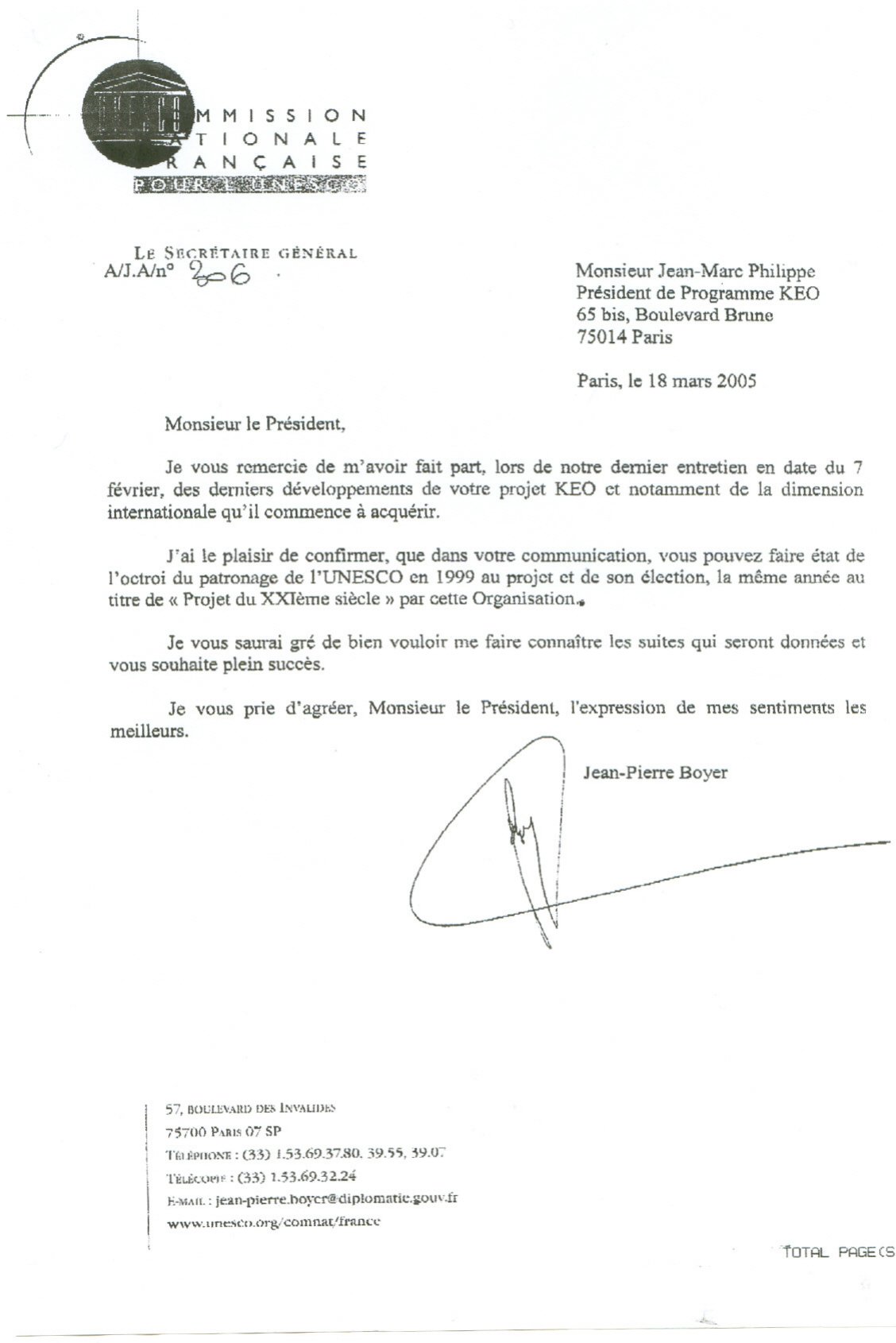
On 18 March 2005, the Commission nationale française pour l'UNESCO, through its Secretary-General Jean-Pierre Boyer, confirmed in writing that KEO could continue to claim the patronage granted in 1999 and its title of “21st-Century Project”.
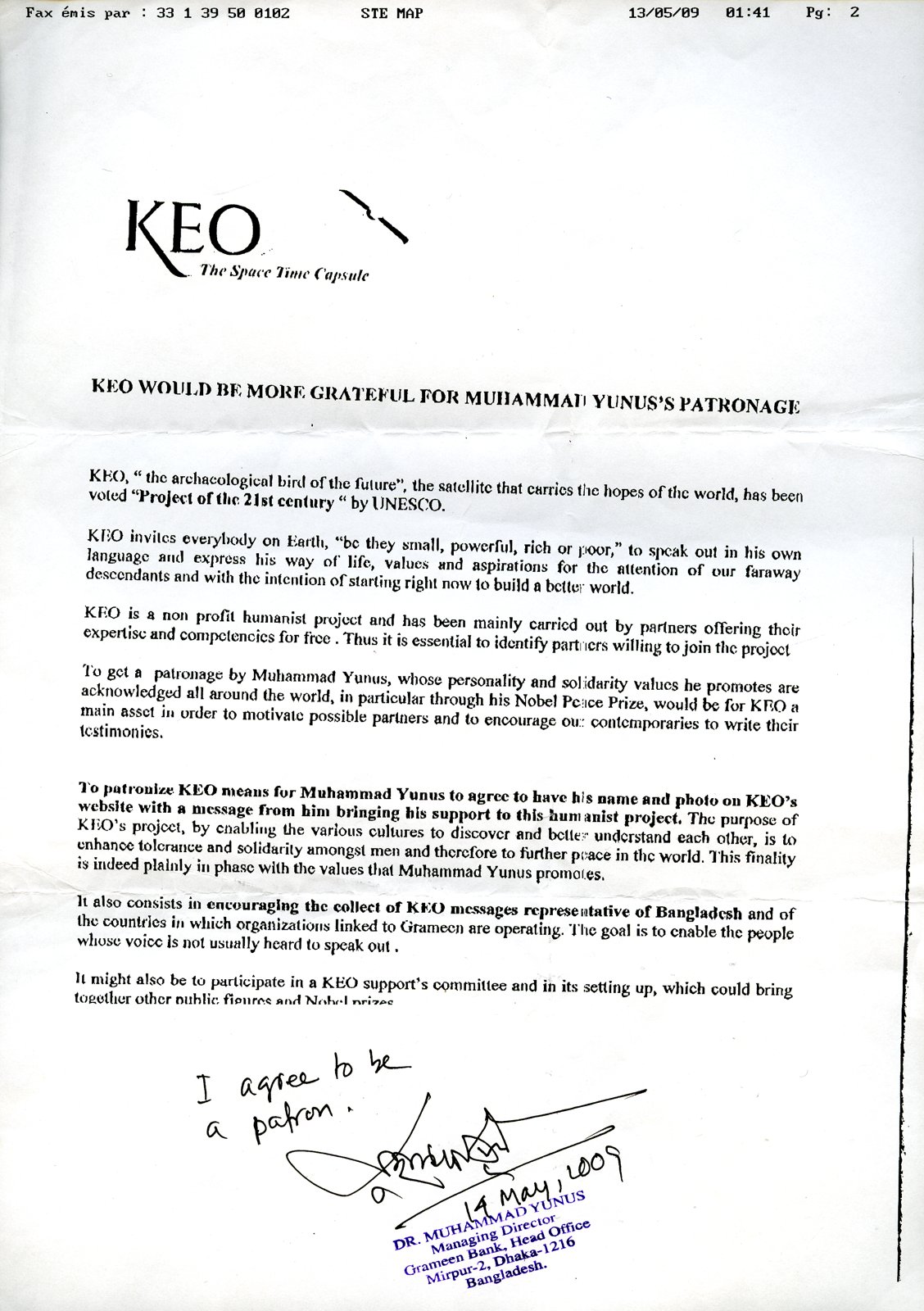
On 14 May 2009, six months after Jean-Marc Philippe's death, Muhammad Yunus, 2006 Nobel Peace Prize laureate and founder of the Grameen Bank, responded to a request for patronage by signing the words “I agree to be a patron”. A later appeal letter, addressed to the founder of the Virgin group in order to revive a project that had been in abeyance since 2008, puts forward this support.
A launch postponed again and again
Several dates were announced, from late 2003 to 2018. The project relied on donated expertise, and those in charge of it explained the postponements by the restructuring of the space industry at the end of the 1990s, the space recession of 2000 to 2002, the attacks of 11 September 2001, the reorganisation of CNES, the failure of an Ariane 5 launch in December 2002 and the flagging commitment of certain partners. In 2019, the president of the association acknowledged that this model was no longer viable: what was needed was a moral sponsor, a few patrons and companies under contract.
The partners
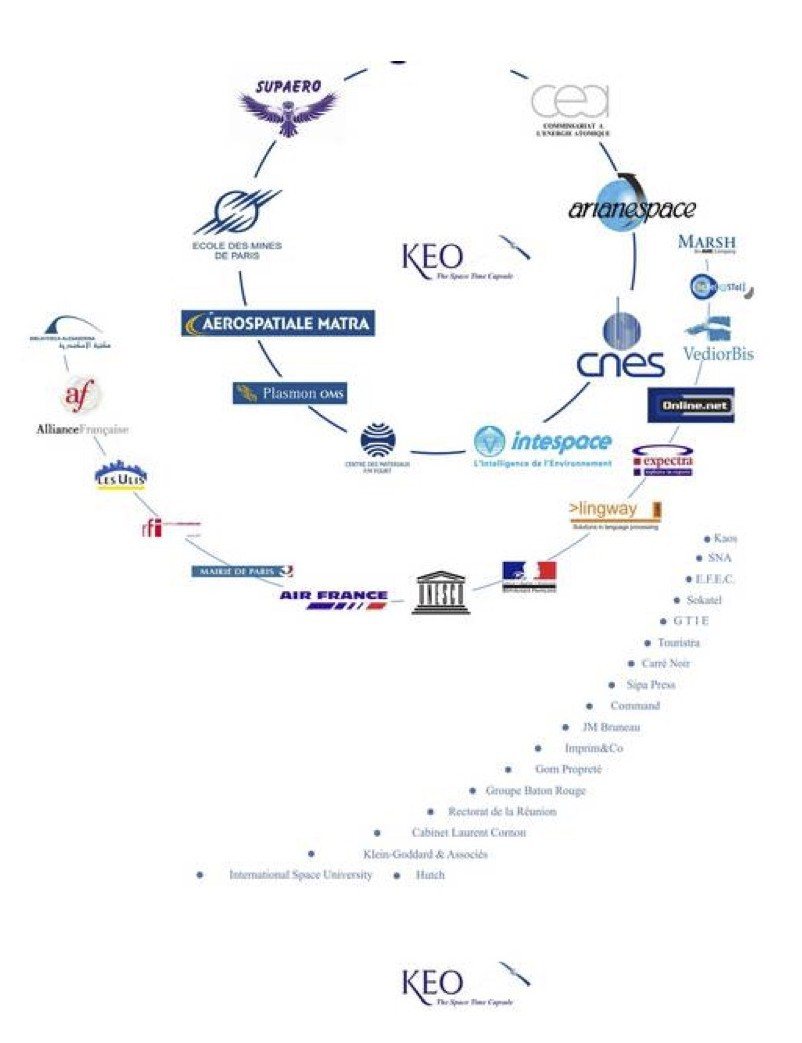
“Carried out free of any political, religious or commercial influence”, KEO brought together more than forty companies and institutions that lent their support free of charge.
- Construction and launch of the satellite: Aérospatiale Matra and later EADS, Arianespace and Starsem, the CEA, CNES, the École des mines de Paris, Intespace, Sup'Aéro, Plasmon (engraving of the glass discs).
- Institutions: UNESCO, the European Space Agency, the International Olympic Committee, the International Federation for Human Rights, the Ligue des droits de l'homme, the Alliance française, the Ministry of Foreign Affairs, the Musée du Louvre, the Musée de la civilisation in Quebec City.
- Communication and computing: BaBeL@StaL (the keo.org website, Ars Electronica prize 1999), Carré Noir, Kaos, Mikros Image, RFI, Cable & Wireless, Lingway, among others.
At the exhibitions, technology showcases presented the materials of the satellite, lent by the partner laboratories.
Why they joined KEO
The press kit sets out the partners' reasons. Patrick Tejedor, then director of human resources development at the Aérospatiale group, met Jean-Marc Philippe in May 1995, over a project that was not yet called KEO; he saw in it an opportunity for the personal fulfilment of the employees, a vehicle for the company's image and a showcase for its expertise: trajectory calculation, launch, atmospheric re-entry, difficult materials. Intespace devoted several weeks of testing to reproducing the hostile environment that the satellite would face. To find the name, one of the partners, the Kaos agency, had the idea of looking for the sounds common to the most widely spoken languages.
The institutions followed. Antonio Rodotà, Director General of the European Space Agency, hailed a project combining new technologies, art, humanism and education. The International Federation for Human Rights relayed the appeal to its 105 member organisations, so as to associate the Universal Declaration of Human Rights with the messages. The Ministry of Foreign Affairs organised an exhibition as part of the French presidency of the European Union and invited embassies to act as correspondents for the collection. In September 1999, Senator Paul Loridant discovered the project while preparing the visual arts forum in Les Ulis; the town created the exhibition “Prélude à l'envol de KEO” and organised its presentation abroad.
After 2008
Jean-Marc Philippe died on 12 November 2008. On 20 January 2009, in a tribute, Federico Mayor called for his dream to be brought to fruition: “KEO is in this sense the very model of a successful cross-fertilisation between tangible heritage and intangible heritage, between the sciences and the Arts, between the future and the past.” Patrick Tejedor, president of the KEO Programme association, then sought new partners; on 22 November 2012, at the Maison de l'UNESCO, the Fonds international pour la promotion de la culture announced that it was taking up the torch. The satellite has not been launched. The team continued the collection of messages until 2025, the year in which it came to an end and the keo.org website closed.
Tribute from Federico Mayor
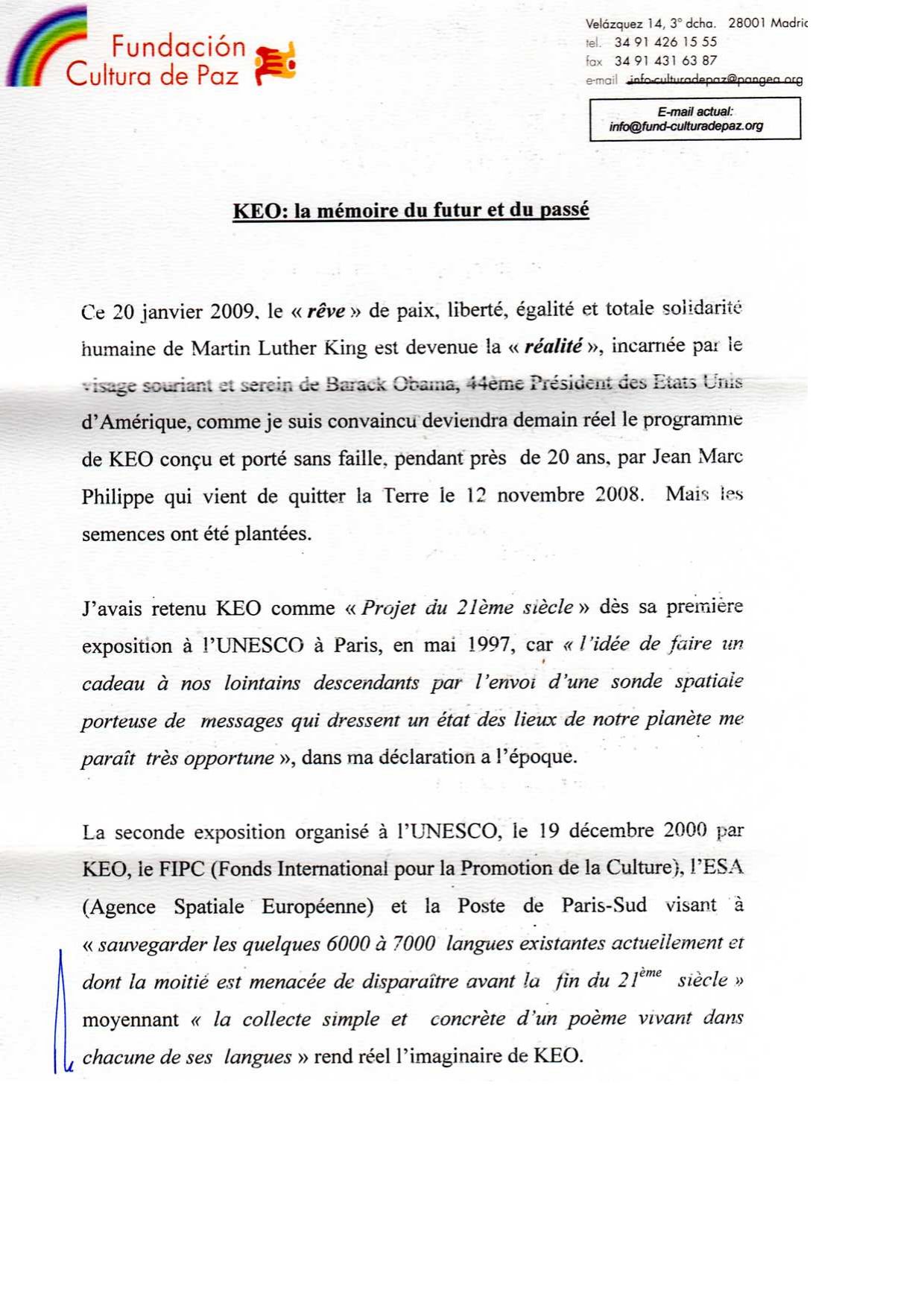
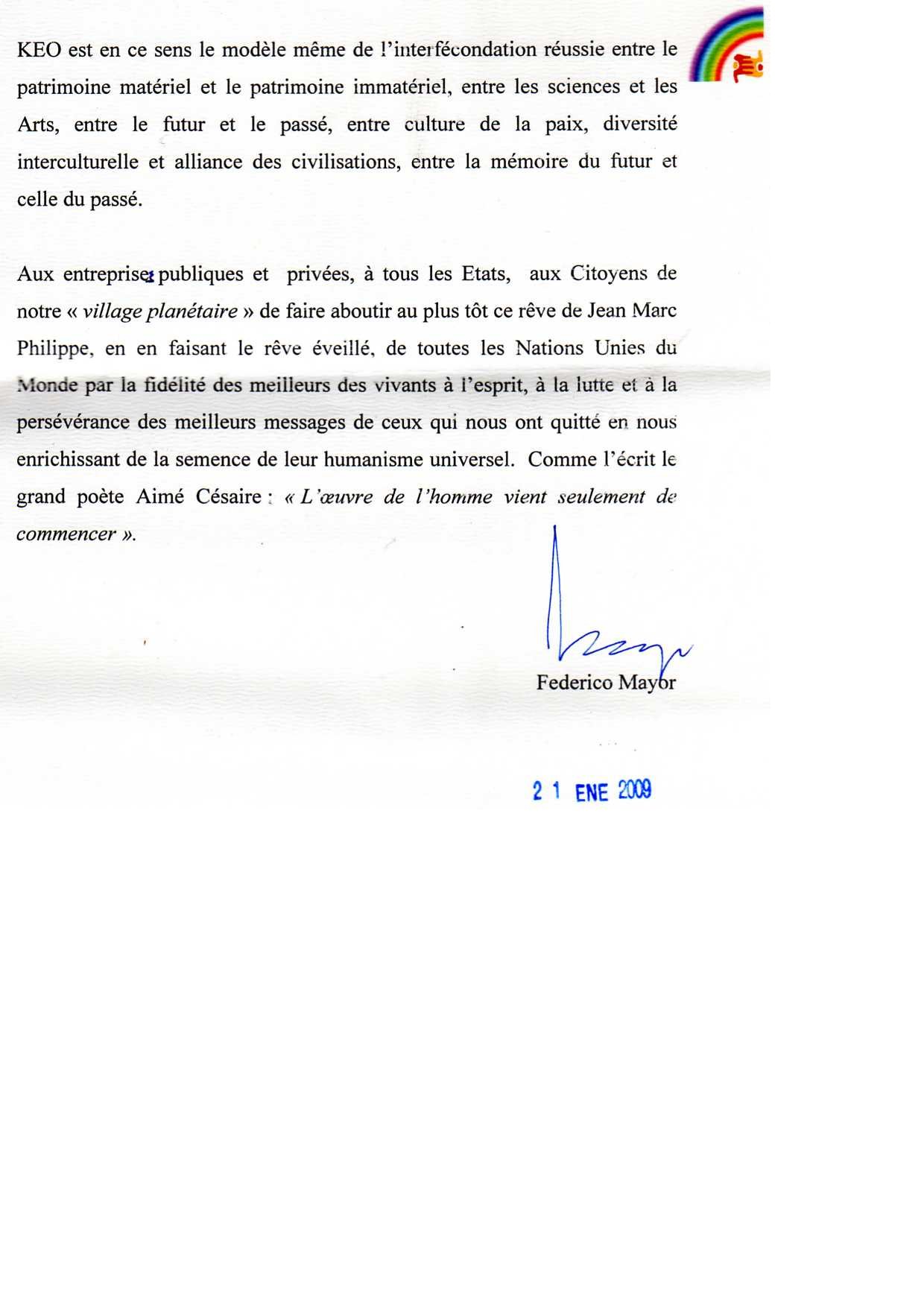
On 20 January 2009, the day of Barack Obama's inauguration, Federico Mayor, former Director-General of UNESCO, wrote on the letterhead of the Fundación Cultura de Paz in Madrid a text entitled “KEO: The Memory of the Future and the Past”. In it he links Martin Luther King's dream, which became reality that day, with the KEO programme, carried forward “unfailingly” by Jean-Marc Philippe, recalls the exhibition of 19 December 2000 devoted to safeguarding languages, and concludes with an appeal to businesses, to States and to the citizens of the “planetary village”, and with a sentence by Aimé Césaire.
KEO: The Memory of the Future and the Past
On this 20 January 2009, Martin Luther King's “dream” of peace, freedom, equality and total human solidarity has become “reality”, embodied by the smiling and serene face of Barack Obama, 44th President of the United States of America, just as, I am convinced, the KEO programme will tomorrow become real, conceived and carried forward unfailingly, for nearly 20 years, by Jean Marc Philippe, who has just left the Earth on 12 November 2008. But the seeds have been planted.
I had selected KEO as a “21st-Century Project” from its very first exhibition at UNESCO in Paris, in May 1997, because “the idea of making a gift to our distant descendants by sending a space probe carrying messages that take stock of our planet seems to me most timely”, in my statement at the time.
The second exhibition organised at UNESCO, on 19 December 2000, by KEO, the FIPC (International Fund for the Promotion of Culture), ESA (European Space Agency) and the Paris-Sud Post Office, aiming to “safeguard the some 6,000 to 7,000 languages existing today, half of which are threatened with disappearance before the end of the 21st century” by means of “the simple and concrete collection of a living poem in each of its languages”, makes the imaginary of KEO real.
KEO is in this sense the very model of a successful cross-fertilisation between tangible heritage and intangible heritage, between the sciences and the Arts, between the future and the past, between a culture of peace, intercultural diversity and the alliance of civilisations, between the memory of the future and that of the past.
It is for public and private enterprises, for all States, for the Citizens of our “planetary village” to bring this dream of Jean Marc Philippe to fruition as soon as possible, by making it the waking dream of all the United Nations of the World, through the fidelity of the best of the living to the spirit, the struggle and the perseverance of the best messages of those who have left us, enriching us with the seed of their universal humanism. As the great poet Aimé Césaire writes: “The work of man is only just beginning”.
Federico Mayor
References and links
Books, catalogues and journals
- Jacques Mousseau, “Kéo, l'oiseau communicant”, Communication & Langages, no. 122, 1999, pp. 4-10 (Persée).
KEO press
- Declan Butler, “Space 'time capsule' could send a message to the future”, Nature, no. 391, 8 January 1998 (online).
- Véronique Maurus, “Retour vers le futur”, Le Monde, 16 August 1998 (online).
- Jean-Marie Decorse, “Avec Keo, rendez-vous dans 50.000 ans”, La Dépêche du Midi, 15 May 1999 (online).
- “Keo en route pour le futur”, L'Humanité, 18 March 2000 (online).
- Pierre Barthélémy, “Le satellite KEO attend vos messages pour les Terriens du DXXIe siècle”, Le Monde, 12 July 2002 (online).
- John Lichfield, “Time capsule to orbit planet earth for 50,000 years”, Irish Independent, 12 July 2002 (online).
- Karishma Upadhyay, “Around the universe in 50,000 years”, The Times of India, 17 September 2002 (online).
- Marie-Julie Gagnon, “Retour vers le futur”, La Presse (Montreal), 20 February 2004.
- Elisabeth Chardon, “La Bâtie sert de relais à KEO, une œuvre planétaire qui attend encore la participation des Suisses”, Le Temps, 4 September 2004 (online).
- “Iran: KEO Initiator Expected”, Iran Daily, 16 February 2005 (online).
- “Near-Art Object”, Wired, 1st May 2006 (online).
- “Capsules temporelles, bouteilles à la mer et messages au cosmos”, Le Figaro, 10 October 2006 (online).
- Marc Vandermeir, “KEO, le satellite de vos espoirs”, La Libre Belgique, 6 April 2007 (online).
- “México en cápsula del tiempo que atestiguará el hoy”, Cuarto Poder (Chiapas) (online).
- Millie Servant, “10 ambitieuses capsules temporelles destinées aux générations futures”, Usbek & Rica, 17 June 2023 (online).
- Santiago Vargas, “Satélite KEO: el proyecto para enviarle un mensaje a la humanidad del año 52.000”, El Tiempo, 22 January 2024 (online).
- Claire L. Evans, “If We Want Anyone to Remember Humanity, We Need to Talk About Time Capsules”, Vice (online).
Online resources
- Prix Ars Electronica 1999, Ars Electronica archives.
- “KEO (satellite)” article, Wikipedia (French).